The Honda That Knew Too Much:
Canadian Alien Finds Secret Books to Repair His Spaceship
For decades, scientists wondered how one small Canadian alien managed to repair a completely destroyed interstellar spacecraft using nothing more than ordinary tools and a suspicious amount of confidence.
The answer has finally been revealed.
It all began when the stranded alien, known only as Gary from Sector Maple-7, purchased an old Honda from a friendly Canadian.
While trying to replace the air filter, he accidentally discovered a hidden compartment inside the engine bay.
Inside were seven dusty books.
Not ordinary books.
Ancient engineering manuals written by a mysterious civilization that apparently understood both quantum mechanics and reliable fuel economy.
Among the titles were:
- How to Repair an Interstellar Spaceship Using Everyday Canadian Tools
- Quantum Engines for Beginners
- The Secret Relationship Between Maple Syrup and Warp Drives
- Advanced Alien Mechanics (Honda Collector's Edition)
- How to Make Strange Noises Disappear Without Panic
- The Universal Owner's Manual
- Why Hondas Refuse to Give Up
According to Gary, everything suddenly made sense.
"I spent twenty-three Earth years trying to repair my ship. Then I found Book Number Three.
The engine started on the first try."
Witnesses reported hearing the spacecraft quietly humming before lifting off with perfect reliability.
Experts remain confused.
Some engineers insist the books are impossible.
Honda owners simply smiled and said, "Sounds about right."
A Promise Never Forgotten
Before leaving Earth, Gary made one promise.
"I will never forget Honda."
He has kept that promise ever since.
Twice every Earth year, Gary returns from his home planet for one very specific mission.
Not to visit world leaders.
Not to inspect military bases.
Not even to collect maple syrup.
He flies directly to Japan.
His silver spaceship quietly lands a respectful distance from Honda headquarters before sunrise.
Security cameras have repeatedly captured what appears to be a small alien placing flowers, polishing an old Honda Civic with incredible care, and leaving handwritten thank-you cards that simply read:
"Your engineers saved my civilization."
Employees arriving for work occasionally find tiny gifts left behind:
- Perfectly polished wrenches made from meteorite metal.
- Coffee mugs that never become empty.
- Anti-gravity screwdrivers.
- Self-organizing toolboxes.
- A lifetime supply of universal 10 mm sockets that never disappear.
Nobody knows where they come from.
Maintenance staff have stopped asking questions.
The Secret Society of Honda Owners
Rumors now suggest longtime Honda owners are actually members of an unofficial intergalactic appreciation club.
Their only rule?
Never reveal why the cars seem to last forever.
Members simply nod knowingly whenever another Honda reaches 500,000 kilometers.
Coincidence?
Gary doesn't think so.
Looking Toward the Future
Astronomers occasionally detect an unidentified spacecraft entering Earth's atmosphere every spring and every autumn.
Governments issue routine statements saying there is "nothing unusual to report."
Meanwhile, employees at Honda headquarters quietly notice that every time the mysterious visitor arrives, one parking spot somehow contains a fresh bouquet of flowers and a note that reads:
"Thank you for helping me find my way home."
No one has ever seen the visitor leave.
But every six months, someone discovers a tiny maple leaf sticker on the newest Honda model.
Coincidence?
The alien refuses to comment.
Editor's Note: This article is a work of satire and absurd fiction. Any resemblance to real companies, secret alien civilizations, hidden libraries inside cars, or annual extraterrestrial thank-you visits to Japan is purely for comedic purposes.

Canadian Spiritual Tree Discovers the Ultimate Knowledge Trap, Even the Cats Start Taking Notes
Editor's Note: This article is a work of satire and absurd fiction. Any resemblance to enlightened trees, philosophical cats, or Canadian forests is purely for comedic purposes.
CANADA — A peaceful spiritual maple tree deep inside the Canadian wilderness has reportedly entered an existential crisis after reaching what experts are calling "Level 999 Wisdom."
The breakthrough came after reading thousands of books on philosophy, psychology, spirituality, quantum physics, meditation, gardening, maple syrup optimization, and the mysterious behavior of squirrels.
Witnesses say the tree suddenly froze, stared into the distance for nearly six hours, and quietly whispered:
"Wait... if every answer creates ten new questions... then the more I know... the less I actually know."
The forest fell completely silent.
Even the wind reportedly paused out of respect.
Nearby beavers stopped building dams.
The moose slowly nodded without understanding why.
A flock of geese immediately flew south despite it being the middle of summer.
Forest Universities Enter Emergency Mode
Within minutes, professors from the Canadian Forest Academy gathered beneath the giant maple.
Scientists began taking measurements.
Monks meditated.
Owls pretended they had already known this all along.
No one could explain why the oldest tree in Canada suddenly looked both incredibly wise and completely confused at the same time.
One researcher summarized the situation:
"He has achieved maximum enlightenment... unfortunately that also means realizing how little anyone actually understands."
Even the Cats Are Taking Notes
Perhaps the strangest development came from the local cats.
Normally famous for ignoring absolutely everything, dozens of cats quietly surrounded the tree carrying tiny notebooks and miniature pencils.
Not a single one meowed.
Instead they listened carefully while writing pages of notes titled:
- Pretend You Know Less.
- Nap Before Every Big Question.
- Curiosity Burns Calories.
- Humans Think They Own Us... Interesting Theory.
One particularly serious orange cat reportedly looked up from his notebook and declared:
"I've suspected this for years. That's why I sleep eighteen hours a day."
Forest philosophers immediately added the quote to their curriculum.
The Great Canadian Wisdom Equation
Officials have now posted a new equation throughout the forest:
More Knowledge = Bigger Mystery
or, as the tree prefers to explain it:
"Learning isn't climbing to the top of the mountain. It's discovering the mountain keeps getting taller."
Visitors have started arriving simply to sit beneath the tree and contemplate life... although most eventually become distracted by squirrels stealing their sandwiches.
A Surprisingly Peaceful Ending
Despite the confusion, the spiritual tree insists the discovery is actually wonderful.
"If I already knew everything," the ancient maple explained, "life would become terribly boring."
The cats all nodded in agreement before carefully closing their notebooks and returning to their favorite activity:
Doing absolutely nothing while looking far wiser than everyone else.
Scientists remain puzzled.
The squirrels have started selling unofficial copies of the cats' notes.
And somewhere in the Canadian forest, one old maple continues smiling, happily discovering that every answer is simply the beginning of a brand-new adventure.

Futuristic French Radio DJ Demoted to Hell's Door-to-Door Department, Forced to Wear Brown Rice Shoes
Editor's Note: This article is a work of satire and absurd fiction.
Any resemblance to real radio personalities, broadcasting companies, infernal management, or footwear made from brown rice is purely coincidental and intended for comedy.
From Galactic Airwaves to Infernal Doorbells
HELL — Listeners across the galaxy were stunned this week after one of France's most famous futuristic radio DJs was officially demoted by the Infernal Broadcasting Authority.
His crime?
"Excessive positivity."
According to leaked documents, Hell's executives became increasingly concerned that the DJ's cheerful music, uplifting jokes, and unexpectedly wholesome interviews were making the underworld feel "a little too pleasant."
After a brief 13-second disciplinary meeting, he was reassigned to the Department of Door-to-Door Motivation.
His new mission:
Visit every home in Hell until the gardens become "slightly more adequate."
A New Career Begins
Instead of broadcasting from a state-of-the-art radio studio with holographic mixing decks and anti-gravity speakers, the former superstar now walks endless lava streets carrying brochures titled:
"Five Easy Ways to Make Your Garden Slightly Less Terrifying."
Witnesses say he politely knocks on every fiery front door.
"Good afternoon! Have you considered planting flowers instead of flaming thorn bushes?"
Most residents simply blink.
One demon reportedly replied,
"We usually grow screaming pumpkins."
The DJ handed him a packet of sunflower seeds anyway.
The Legendary Brown Rice Shoes
Perhaps the strangest part of his new assignment is his mandatory footwear.
Instead of futuristic hover boots, management issued him a pair of shoes handcrafted entirely from compressed organic brown rice.
Officials claim the shoes promote "humility, balance, and excellent ankle posture."
The downside?
Every few kilometers, hungry pigeons from the Upper Atmosphere try to nibble on them.
The shoes also produce a faint crunching sound with every step.
Crunch...
Crunch...
Crunch...
Hell's acoustics department has officially classified the sound as "surprisingly relaxing."
Demons Are Slowly Warming Up
After months of knocking on doors, something unexpected happened.
Tiny flowers began appearing between volcanic rocks.
Several lava rivers received decorative bridges.
One particularly grumpy demon installed a bird feeder.
Another replaced his moat of boiling tar with a koi pond.
Nobody knows where the koi came from.
Even Lucifer reportedly paused during his afternoon lava jacuzzi to admire a freshly planted rose bush.
"It's... annoyingly beautiful," he admitted.
Even the Cats Have Joined the Mission
No great galactic event would be complete without the Research Cats.
A team of highly serious feline observers quietly followed the former DJ from house to house, writing detailed notes in waterproof notebooks.
Their conclusions included:
- Brown rice apparently works as footwear.
- Gardens improve morale.
- Kindness spreads faster than gossip.
- Never underestimate a radio host with a watering can.
One elderly tabby adjusted his tiny glasses before writing:
"Perhaps paradise begins with knocking on the first door."
Forest philosophers immediately requested a signed copy.
Hell Gets a Surprise Makeover
Months later, Hell's inspectors returned expecting failure.
Instead, they discovered colorful gardens, smiling neighbors, freshly painted fences, and surprisingly good community spirit.
Even the infernal mailbox competition had become strangely wholesome.
The Broadcasting Authority reluctantly admitted that perhaps sending a radio DJ door-to-door had not been the punishment they imagined.
As for the former DJ?
He simply smiled, brushed the ash from his brown rice shoes, rang another doorbell, and cheerfully asked:
"Bonjour! Would you like a free packet of sunflower seeds?"
Several demons said yes.
The flowers are still growing.
🥬 Elephant Discovers His Chain Was Made of Lettuce All Along, Walks Away After Lunch
Editor's Note: This article is a work of satire and absurd fiction. Any resemblance to real elephants, lettuce chains, or vegetable-based security systems is purely for comedic purposes.
The Great Escape Nobody Expected
The world's oldest elephant mystery may have finally been solved.
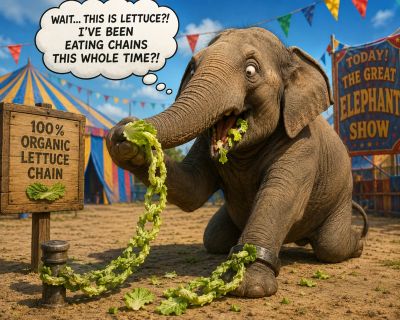
Visitors at the Galactic Wildlife Awareness Reserve watched in disbelief this morning as a gentle elephant named Harold stared thoughtfully at the chain wrapped around his leg before casually taking a bite out of it.
Within seconds...
Crunch.
Another bite.
Crunch.
Three minutes later, the entire "chain" had disappeared into Harold's stomach.
Witnesses reported the elephant stood still for a few seconds, looked around in complete confusion, and slowly realized...
"I... could have left whenever I wanted."
The crowd burst into applause as Harold calmly wandered toward the snack stand in search of dessert.
Scientists Left Speechless
Researchers immediately inspected the remains of the so-called restraint.
To everyone's embarrassment, laboratory tests confirmed the chain consisted of:
- 98% fresh lettuce
- 2% salad dressing
- Zero actual metal
"It appears someone accidentally ordered the Vegan Maximum Security package," admitted one researcher while trying not to laugh.
Alien Psychology Department Explains Everything
Experts from the Intergalactic Institute of Positive Confusion explained that the experiment wasn't about physical strength.
It was about belief.
According to Professor Zorbax of Planet Kale, many creatures continue carrying invisible limitations simply because they never question them.
"The elephant wasn't trapped by lettuce," the professor explained.
"He was trapped by yesterday's assumptions."
The statement was immediately printed on thousands of motivational posters across the galaxy.
The Salad Security Industry Collapses
Following the incident, lettuce-chain manufacturers saw their stock prices tumble overnight.
Several companies announced emergency upgrades including:
- Broccoli handcuffs
- Celery ropes
- Organic cucumber padlocks
- Premium kale security systems with ranch dressing resistance
None are expected to perform significantly better.
Bees Begin Taking Notes
Nearby bees reportedly landed on flowers while writing tiny notes in microscopic notebooks.
One bee summarized the day's lesson perfectly:
"Sometimes the thing keeping you stuck isn't stronger than you...
...it's just tastier than you realized."
The hive has since announced a new university course titled Edible Obstacles and Advanced Personal Growth.
Harold's New Mission
Now completely free, Harold has accepted a new role as the galaxy's first Chief Motivation Elephant.
His seminars are surprisingly simple.
Step 1: Look carefully at what's holding you back.
Step 2: If it's lettuce...
Eat it.
Thousands have already signed up for the next conference, although organizers have reminded attendees that not every life problem should literally be eaten.
Harold, meanwhile, remains optimistic.
He's currently investigating whether the nearby fence is secretly made of celery.
Aliens Reveal the Ultimate Breakfast Secret: Frying Eggs With Pure Brainpower
Joint Human–Alien Space Station – Orbit Somewhere Above Earth
After decades of arguing about whether aliens existed, humanity has finally reached the important questions.
Not world peace.
Not faster-than-light travel.
Not the meaning of life.
How do you cook an egg without a frying pan?
This week, aboard the Joint Human–Alien Space Station, Earth welcomed its first official interstellar cooking class, hosted by Chef Zorblax of the Galactic Breakfast Council.
The lesson was titled:
"Thinking Sunny Side Up: An Introduction to Telepathic Cuisine."
According to Chef Zorblax, primitive civilizations rely on heat.
Advanced civilizations simply glare at breakfast until it cooperates.
"We have not used stoves for twelve thousand years," explained the chef while levitating six eggs around the kitchen.
"The egg already knows it wants to become breakfast. You merely encourage it."
The human astronauts nodded politely.
Then immediately asked where the microwave was.
The First Human Attempt
Students were instructed to place an uncooked egg in a floating pan, close their eyes, and imagine the perfect breakfast.
For several minutes...
Nothing happened.
One astronaut accidentally thought about pizza.
The egg became slightly Italian.
Another participant remembered their ex.
The egg somehow became hard-boiled out of pure emotional pressure.
A Canadian astronaut imagined maple syrup so intensely that nearby pancakes appeared despite nobody bringing pancake batter aboard.
NASA scientists immediately labeled this event:
"Statistically Delicious."
Alien Cooking Techniques
The aliens demonstrated several advanced culinary methods that have been perfected across thousands of galaxies.
Among them:
- Soft-boiled using calm thoughts.
- Scrambled using mild confusion.
- Poached through peaceful meditation.
- Omelets created by collective optimism.
- Extra crispy by thinking about paying taxes.
One student accidentally pictured a dinosaur.
The egg hatched.
The dinosaur politely asked for toast.
Scientific Observations
Researchers quickly discovered that human brains produce several unexpected cooking effects.
Thinking about Monday mornings burned the eggs instantly.
Thinking about vacations produced perfectly fluffy omelets.
Thinking about social media notifications caused eggs to vibrate nervously for several minutes.
Thinking about pineapple on pizza almost started an interstellar diplomatic incident.
Fortunately, Galactic mediators arrived with complimentary muffins before the debate could escalate.
Graduation Day
After eight hours of intense concentration, one determined astronaut finally succeeded.
Without touching the pan...
Without electricity...
Without fire...
A beautiful sunny-side-up egg slowly appeared.
The room erupted in applause.
The aliens celebrated by awarding the human a glowing Golden Spatula of Consciousness, one of the highest culinary honors in the galaxy.
"It's not about controlling the egg," said Chef Zorblax while floating upside down. "It's about believing breakfast believes in you."
The graduating astronaut wiped away a tear.
Then accidentally overcooked twelve more eggs by becoming too emotional.
What's Next?
The Joint Human–Alien Space Station has already announced its next series of revolutionary classes.
Upcoming lessons include:
- Making popcorn with positive thinking.
- Convincing vegetables to season themselves.
- Brewing coffee through collective optimism.
- Teaching burnt toast to forgive itself.
- Advanced telekinetic bacon for students who pass the egg exam.
Earth's greatest chefs have already requested enrollment.
Meanwhile, restaurant owners everywhere are reportedly nervous.
If customers can eventually cook breakfast using only their minds...
Who is going to buy frying pans?
Manufacturers remain optimistic.
After all, somebody still has to wash the dishes.
Even if they float in zero gravity.

Earth Generals Attend Top-Secret Alien Seminar, Forget About World Domination for Exactly 47 Minutes
CLASSIFIED – PROBABLY
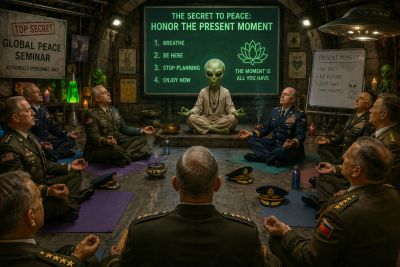
In what officials are describing as "absolutely not a meditation retreat," dozens of Earth's highest-ranking military generals quietly disappeared this weekend to attend a highly classified seminar hidden somewhere beneath an ordinary-looking parking garage.
The guest speaker?
A seven-foot-tall alien spiritual teacher known only as Master Zol'An, whose résumé simply reads:
"Has successfully convinced three galaxies to stop arguing before lunch."
Witnesses say the seminar began with the generals expecting a presentation on advanced defense systems, quantum shields, and anti-gravity battle cruisers.
Instead, the alien dimmed the lights, smiled warmly, and said:
"Welcome. Today we will practice... doing absolutely nothing."
Several generals immediately requested a tactical briefing.
"There isn't one," replied Master Zol'An.
The room reportedly became more uncomfortable than any military exercise in recorded history.
Step One: Put Down the Phone
Each participant was instructed to place their encrypted satellite phone into a basket labeled:
"Things That Can Wait 45 Minutes."
One general stared at the basket for nearly ten minutes before asking if it was a psychological operation.
"It is," answered the alien.
"It is called... relaxing."
The Great Breathing Exercise
The next challenge seemed simple.
Everyone had to take one slow breath.
No planning.
No meetings.
No thinking about tomorrow.
Just breathing.
According to insiders, several participants instinctively tried to create a committee to discuss the breathing procedure before actually taking the breath.
Master Zol'An simply nodded.
"Excellent. You have identified... your problem."
A Revolutionary Discovery
The seminar continued with an astonishing lesson.
The alien projected a giant glowing slide onto the wall.
It contained only four words:
"This moment is enough."
Silence filled the room.
One general cautiously raised his hand.
"So... no five-year strategy?"
"No."
"No emergency protocol?"
"No."
"No contingency binder?"
"No."
"What about snacks?"
"Always snacks."
The audience erupted into the loudest applause of the afternoon.
Coffee Break of Enlightenment
During intermission, instead of coffee, participants were served warm herbal tea from floating crystal cups.
Several generals admitted they hadn't watched steam rise from a cup in over twenty years.
One quietly whispered,
"I didn't know tea had... personality."
Nobody laughed.
Mostly because they were busy watching tiny bubbles.
The Present Moment Drill
The final exercise required everyone to spend five uninterrupted minutes simply observing a flower.
No tactical assessment.
No threat evaluation.
No satellite imagery.
Just...
Flower.
Reports indicate this was the most difficult mission of the entire seminar.
One participant reportedly complimented the flower on its excellent camouflage.
Master Zol'An considered that acceptable progress.
Graduation Ceremony
At the end of the session, every attendee received a small glowing certificate that read:
Certified Beginner in Remembering That Right Now Exists.
Instead of medals, the graduates received tiny golden bells.
Whenever someone begins overthinking, they simply ring the bell and remember to smile.
Military officials insist the bells have "no strategic purpose whatsoever."
The aliens politely disagree.
The Galactic Conclusion
As the seminar ended, Master Zol'An addressed the room one final time.
"The strongest civilization is not the one that worries the most."
He looked around at the silent audience.
"It is the one that can enjoy one peaceful cup of tea before checking its email."
The room remained perfectly still.
Then, somewhere in the back, someone quietly asked:
"...Can we schedule another seminar next month?"
Master Zol'An smiled.
"You don't need to schedule peace."
"You only need to notice that it has been sitting beside you the whole time."
The generals nodded thoughtfully before returning to their offices, where several were later seen pausing for an extra ten seconds to admire a sunset before opening the next meeting.
Military analysts confirmed it was the calmest ten seconds in modern history.
Alien Loses His Skin and Discovers He Has Been Human the Entire Time
Editor’s Note: This story is fictional satire created for entertainment.
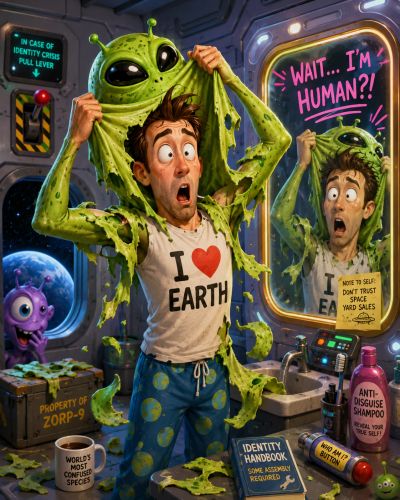
A routine morning aboard the interstellar research vessel Confused Horizon turned into a full-scale identity emergency after an alien crew member accidentally shed his green skin and discovered that he was, in fact, a completely ordinary human.
The incident began shortly after breakfast when Zorp-9, a respected junior officer from the Planet Glibnar, entered the spaceship bathroom to prepare for his shift.
According to witnesses, Zorp-9 had been complaining for several days that his skin felt unusually loose.
“I thought it was space allergies,” he later explained.
“Or maybe the new anti-gravity laundry detergent.
Nobody reads the warning labels.”
While standing in front of the mirror, Zorp-9 scratched behind one of his antennae. A small piece of green skin peeled away.
He pulled it.
Then he pulled a little more.
Within seconds, the entire alien face stretched upward like an old Halloween costume, revealing messy brown hair, human ears and a deeply confused man wearing blue pyjama pants decorated with tiny pictures of Earth.
Zorp-9 stared into the mirror.
The mirror stared back.
After approximately seven seconds of silence, he screamed:
“WAIT… I’M HUMAN?!”
The scream activated three emergency alarms, opened the snack cupboard and accidentally launched an escape pod containing nothing but towels.
A Discovery Nobody Was Prepared For
Crew members rushed to the bathroom expecting a meteor strike, engine failure or another unauthorized karaoke competition.
Instead, they found Zorp-9 standing beside the sink, holding his former alien head above him like a wet green sweater.
Pieces of fake alien skin were scattered across the floor.
A bottle of anti-disguise shampoo sat open on the counter.
The ship’s doctor examined him and confirmed the shocking result.
“He has ten fingers, human teeth and a strong desire to complain about traffic,” the doctor announced. “There is no doubt. This man is from Earth.”
The doctor also discovered that Zorp-9’s antennae were decorative and had apparently been attached using industrial glue purchased at a space yard sale.
This explained why they sometimes pointed in different directions during important meetings.
How Did a Human Become an Alien?
Investigators are now trying to determine how Zorp-9 spent nearly thirty years believing he was extraterrestrial.
One theory suggests he was accidentally adopted by aliens as a baby after they confused his stroller with a diplomatic transport capsule.
Another theory claims he bought the green skin at a costume market and simply forgot he was wearing it.
The most popular explanation, however, involves a malfunctioning identity machine.
According to ship records, Zorp-9 once entered a device labelled:
“Advanced Galactic Personality Enhancer.”
The machine was later discovered to be a vending machine for novelty disguises.
“He pressed the alien button,” said Commander Blip, captain of the vessel.
“Then he walked out green and nobody wanted to embarrass him.”
Crew members admitted they had always suspected something unusual.
Zorp-9 was the only alien who enjoyed coffee, owned a barbecue and became angry when someone put pineapple on pizza.
He also regularly referred to Earth as “home” before quickly correcting himself and saying, “I mean… the target planet.”
Other Aliens Feel Betrayed
The revelation has created tension among the crew.
Several aliens said they felt deceived after learning that Zorp-9’s famous glowing green complexion was mostly shampoo, paint and poor bathroom lighting.
“He told us humans were strange,” said one purple crew member.
“Now we discover he is one of them. Last week, he gave a three-hour lecture about why humans take too many selfies.”
Another officer said Zorp-9 had spent years pretending not to understand human customs.
“He acted confused by birthdays,” she said.
“But we found twelve birthday cards hidden in his locker.”
The crew is also reviewing several suspicious moments from the past.
During one mission, Zorp-9 became emotional after hearing a song from Earth.
He claimed the music activated an ancient alien memory.
It was later identified as a television theme song from the 1990s.
Earth Officials Respond
Officials on Earth have welcomed the discovery but admitted they are not sure which country Zorp-9 belongs to.
He speaks English, French, three alien languages and what experts describe as “extremely poor Spanish.”
His pyjama pants feature images of Earth, but his T-shirt simply says, “I Love Earth,” which investigators say is not valid proof of citizenship.
Several governments have offered to take him in, provided he agrees to share alien technology.
Zorp-9 responded that he does not understand most alien technology and has spent years pretending to press important buttons.
“I mostly work near the coffee machine,” he admitted.
The Identity Crisis Continues
Zorp-9 is now facing a difficult decision.
He can remain aboard the spaceship as the crew’s first official human-alien relations specialist, or return to Earth and attempt to live a normal human life.
For the moment, he has chosen to stay in space.
“I just learned I’m human,” he said. “I’m not ready to deal with taxes.”
He has placed his old alien skin inside a storage box labelled “Emergency Disguise,” although the crew has asked him to wash it first.
The spaceship bathroom has also received a new warning sign:
“Please confirm your species before using anti-disguise shampoo.”
As for Zorp-9, he says he is slowly accepting the truth.
He has begun practising ordinary human activities such as checking the weather, losing passwords and opening the refrigerator without knowing what he wants.
Scientists say his transformation is already nearly complete.
The only remaining mystery is why his medical scan still shows a small antenna growing inside his left sock.
The investigation continues.
Aliens Teach World Military Scientists How to Decode the Karma Code
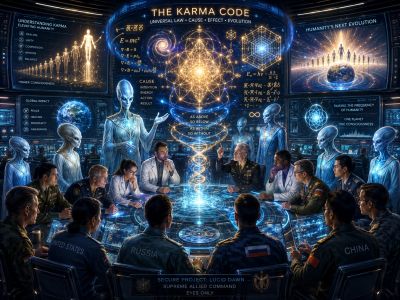
In a development that has confused military commanders, philosophers, laboratory technicians, and at least one extremely nervous government accountant, a highly advanced alien civilization has reportedly taught scientists from the world’s major armed forces how to understand what extraterrestrial researchers call the Karma Code.
The secret lessons allegedly took place inside a heavily protected underground research center known only as Project Lucid Dawn.
According to leaked reports, the Karma Code is not a religion, a weapon, or a new military computer system.
It is described as a universal network of cause, intention, action, and consequence that connects every living being.
The aliens claim the code has always existed.
Humanity simply never learned how to read it.
The Universe Has Been Keeping Records
Alien instructors explained that every thought, decision, and action creates a form of energetic information.
That information travels through people, communities, governments, and eventually entire civilizations.
Kind actions strengthen cooperation and trust.
Dishonest actions create confusion and instability.
Fear spreads more fear, while courage can spread through a population just as quickly.
The alien scientists reportedly compared the Karma Code to an invisible operating system running behind reality.
“You have been pressing buttons for thousands of years without reading the instruction manual,” one alien teacher reportedly told the group.
Several military scientists immediately asked whether the system could be turned off.
The alien replied that this was the most human question possible.
Scientists Discover That Intentions Matter
During the first stage of training, researchers were shown a massive holographic model representing the relationship between intention, energy, action, and result.
The model demonstrated that two people can perform the same action but create very different consequences depending on their motivation.
Helping someone to gain attention does not produce the same effect as helping someone because they genuinely care.
Apologizing only to avoid punishment does not create the same result as understanding the harm that was caused.
The aliens explained that the Karma Code does not judge behavior using human laws, political borders, uniforms, titles, or social status.
It only measures truth, intention, and impact.
This reportedly made several government officials uncomfortable.
One scientist asked whether expensive public-relations campaigns could improve a country’s karmic score.
The aliens stared silently at him for almost thirty seconds.
The question was then removed from the official transcript.
Military Technology Meets Higher Consciousness
At first, world military leaders believed the aliens were offering a new strategic weapon.
They expected advanced propulsion systems, invisible spacecraft, energy shields, or technology capable of predicting enemy movements.
Instead, the aliens introduced concepts such as compassion, personal responsibility, emotional balance, cooperation, and collective consciousness.
Sources say the room became extremely quiet.
Some officials reportedly checked whether they had entered the wrong meeting.
However, after several demonstrations, the military scientists began to understand the potential importance of the discovery.
The alien technology showed how anger, humiliation, poverty, corruption, and fear can spread through a population like a destructive frequency.
It also showed how education, fairness, opportunity, healing, and hope can reverse the process.
The aliens explained that civilizations do not collapse only because of external enemies.
They often collapse because harmful patterns are repeated for generations until the entire society becomes trapped inside them.
The Elevation Program
The scientists have now created a global research initiative known as the Human Elevation Program.
Its official goal is to study how the Karma Code could be used to improve society without turning it into another system of control.
The program is examining how governments might reduce collective fear, improve mental well-being, encourage cooperation, and help communities break destructive cycles.
Researchers are also studying whether schools could teach children how actions affect other people before those children become adults and create international problems.
Early proposals include emotional education, conflict-resolution training, community healing programs, stronger social support, and public campaigns encouraging personal responsibility.
One military commander reportedly asked whether the program could begin with politicians.
The request is still being reviewed.
The Aliens Warn Against Misusing the Code
The extraterrestrial instructors have issued a serious warning.
The Karma Code cannot be used to manipulate a population.
Any government attempting to use it for propaganda, surveillance, forced obedience, or political advantage would create the exact opposite result.
According to the aliens, controlling people through fear damages both the population and the institutions creating the fear.
The code amplifies hidden intentions.
A program presented as helpful but secretly designed for control would eventually produce distrust, resistance, and instability.
The aliens said their own civilization nearly destroyed itself after discovering the code and trying to turn it into a social-ranking system.
They survived only after realizing that spiritual growth cannot be forced.
It must be chosen.
Why the Military Was Selected
Many people may wonder why the aliens chose military scientists instead of monks, spiritual teachers, or philosophers.
The extraterrestrials reportedly said the answer was simple.
Military institutions have enormous resources, advanced technology, global communication systems, and the ability to coordinate across borders during major emergencies.
They also understand consequences.
The aliens believe that if the organizations most familiar with conflict can learn how to reduce it, humanity may finally have a chance to evolve beyond endless cycles of fear and retaliation.
One alien instructor described the military as “a powerful machine that must learn when not to move.”
Several generals reportedly wrote that sentence down.
A New Mission for Humanity
The ultimate purpose of the Karma Code project is not to create perfect people.
The aliens explained that mistakes are part of development.
The real danger begins when individuals and civilizations refuse to learn from their mistakes.
Humanity does not need to become flawless, they said.
It only needs to become conscious enough to recognize its patterns before repeating them.
Scientists now believe the code could help people understand how personal choices connect to global events.
A dishonest decision inside one institution may affect thousands of lives.
A compassionate decision by one person may influence an entire family for generations.
Every action enters the system.
Every intention leaves a signal.
Every civilization eventually experiences the consequences of what it repeatedly creates.
The First Public Test
The first public Karma Code experiment is expected to begin in several unnamed cities.
Residents will not be asked to join a religion or follow alien rules.
Instead, communities will test programs focused on cooperation, fairness, emotional awareness, and repairing harm.
Researchers will observe whether positive actions create measurable improvements in health, safety, trust, and economic stability.
The aliens have advised governments not to announce the project with dramatic speeches, military parades, or giant statues.
They suggested beginning quietly.
“Feed people. Educate children. Repair what is broken. Tell the truth,” one alien scientist reportedly said.
Human officials responded by scheduling a six-month committee meeting to discuss the proposal.
The Code Was Inside Us All Along
Perhaps the most surprising discovery is that the Karma Code may not require alien technology to use.
The holograms, equations, and cosmic symbols simply helped scientists visualize something humanity has always felt intuitively.
Actions have consequences.
Fear creates more fear.
Compassion creates connection.
Dishonesty eventually weakens the person or institution depending on it.
The aliens did not bring humanity a new law.
They brought a way to see an ancient one.
The world’s armies entered the secret laboratory expecting technology that could help them dominate the future.
They may have received something far more powerful.
A chance to understand that the future is created by what humanity chooses to do next.
Editor’s Note: This article is satirical science-fiction created for entertainment, imagination, and reflection.
AreWeReady Alien Newsroom Contacts Every Print Shop in the Galaxy
Editors compare paper quality, delivery speed, ink smell, and the possibility of accidentally bankrupting the newspaper
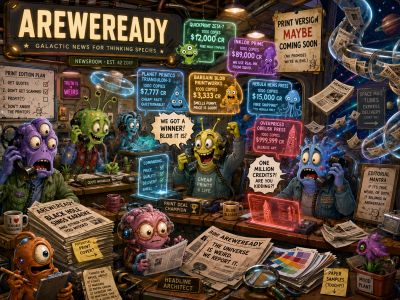
AREWEREADY GALACTIC NEWSROOM — The alien editorial team at AreWeReady has officially begun contacting print shops across the galaxy as part of a highly serious, completely professional, and only slightly chaotic mission to explore the possibility of launching a printed version of the journal.
The project remains unofficial, unconfirmed, unfunded, and surrounded by several nervous accountants.
Nevertheless, the newsroom is already operating as though ten million copies must be printed before breakfast.
Alien editors have spent the past several days calling printers located on distant moons, floating space stations, abandoned asteroid factories, and at least one suspicious warehouse orbiting a planet that does not appear on any map.
“We are only collecting quotes,” explained Zorb McHeadline, AreWeReady’s temporary Director of Possible Paper Products. “Nobody should panic. We have not ordered anything yet.”
Seconds later, another alien editor could be heard shouting across the newsroom:
“WE FOUND A PRINTER WHO ACCEPTS PAYMENT IN CHEESE!”
Hundreds of Galactic Print Shops Contacted
According to newsroom sources, the AreWeReady team has requested prices for several possible print quantities, including:
- 100 copies for curious humans
- 1,000 copies for loyal readers
- 50,000 copies in case the newspaper suddenly becomes famous
- One million copies for distribution on planets where the internet is still considered witchcraft
The first quote came from QuickPrint Zeta-7, a family-owned printing company located inside a refueling station near Saturn.
The company offered 1,000 copies for 12,000 galactic credits and promised free holographic staples.
The second quote came from Bargain Blob Printworks, which offered the same number of copies for only 3,333 credits.
The price immediately attracted the attention of the AreWeReady budget department.
However, the quote included a small warning:
“Newspapers may smell unusual for approximately six months.”
The newsroom is currently debating whether readers would accept a newspaper that smells like boiled space cabbage.
The Most Expensive Quote in Recorded History
Not every printer offered a reasonable deal.
A luxury company called Obelisk Press of Nebula Nine submitted a quote of 999,999 credits for 1,000 copies.
When asked why the price was so high, the company replied:
“Because art.”
The AreWeReady finance alien reportedly dropped three calculators, swallowed a pencil, and asked whether the company planned to print each page on solid gold.
Obelisk Press responded that gold would cost extra.
Another printer offered a premium package that included hand-polished pages, meteorite ink, and delivery by trained cosmic dolphins.
The editorial team declined after learning that the dolphins only deliver on Tuesdays.
Alien Editors Argue About Everything
Choosing a printer has already created intense debates inside the newsroom.
Some editors want thick, luxurious paper.
Others prefer cheaper paper so the newspaper can remain affordable.
One alien insisted that every page should be waterproof in case readers decide to read the journal in the bath.
Another suggested glow-in-the-dark ink so people could read AreWeReady during power outages, alien invasions, or romantic evenings.
The headline department has demanded extra-large pages because, according to them, “important galactic stories need room to breathe.”
The photography department wants glossy paper.
The environmental department wants recycled moon dust.
The accounting department wants everyone to stop having ideas.
Delivery Could Be Complicated
Printing the newspaper is only part of the challenge.
The team must also determine how physical copies would reach readers on Earth.
Traditional delivery companies have raised concerns about transporting newspapers through asteroid fields, customs offices, wormholes, and downtown Montreal during construction season.
One galactic courier offered same-day delivery to Mars but estimated that delivery to Canada could take between three days and forty-seven years.
Another company promised to send the newspapers through high-speed space mail tubes.
Unfortunately, the demonstration ended when several test newspapers were launched directly into a black hole.
The courier described the incident as “a minor routing problem.”
What Would Be Inside the Print Edition?
Although no final decision has been made, the proposed print version could feature a selection of AreWeReady’s strangest reports, funniest alien investigations, cultural chronicles, fictional interviews, suspicious scientific discoveries, and practical advice for surviving a universe that makes very little sense.
Possible sections include:
Universal Newsroom
The latest absurd developments from Earth and beyond.
Alien Culture
A guide to understanding extraterrestrial customs, fashion, food, sports, and diplomatic misunderstandings.
Humanity Watch
Aliens attempt to understand taxes, traffic, dating apps, office meetings, and why humans stand in line for coffee.
Galactic Gallery
Illustrations and photographs documenting important events that almost certainly never happened.
Emergency First Contact Guide
What to say when an alien arrives at your door and asks to borrow your Wi-Fi password.
The Printed Newspaper May Become a Collector’s Item
Some newsroom employees believe a physical version of AreWeReady could become a rare collector’s item.
“Websites are excellent,” said one alien editor while sitting on a mountain of paper samples. “But you cannot dramatically slam a website onto a table during an argument.”
A printed edition could also be placed in cafés, waiting rooms, bookstores, hotels, alien embassies, barber shops, spaceships, and secret underground government facilities.
One editor suggested printing a limited first edition with a numbered certificate.
Another suggested including a mysterious blank page labeled:
“Classified by the Galactic Government.”
Nobody knows what would be classified, but the marketing department strongly supports the idea.
No Promises, Earthlings
Despite the excitement, the AreWeReady team insists that the print version is still only being explored.
There is no official release date.
There is no confirmed price.
There is no final format.
There is not even agreement on whether the newspaper should be folded horizontally, vertically, diagonally, or through a temporary portal.
For now, alien redactors will continue comparing quotes, requesting paper samples, negotiating shipping costs, testing inks, and attempting to understand why printing becomes more expensive every time someone says the word “premium.”
“We want to create something fun, strange, intelligent, and worth keeping,” said Zorb McHeadline. “But first, we need to find a printer who will not charge us the price of a small moon.”
The search continues.
The print version of AreWeReady may be coming soon.
Or later.
Or immediately after the accounting alien stops screaming.
Editor’s Note: This article is satire and fictional entertainment.
No alien print shops were financially harmed during the quote-comparison process.
Canadian Beaver Teaches American Bald Eagle How to Apply Makeup Without Eating It
OTTAWA — In what officials are calling a historic breakthrough in cross-border beauty education, a Canadian beaver has begun teaching an American bald eagle how to apply makeup “like a boss” while repeatedly reminding the confused bird that lipstick is not food.
The private lesson took place inside a small beauty studio near the Canada–United States border, where Beverly Maplewood, a certified beaver makeup coach, welcomed her newest student, Captain Freedom Feathers.
The eagle arrived wearing an American flag headband and carrying what he believed was “a box of colorful emergency snacks.”
It was actually a makeup kit.
“I knew we had work to do when he opened the lipstick, smelled it and asked whether it was cherry-flavored,” Beverly said.
“I told him beauty products go on the face, not in the stomach.”
Captain Freedom Feathers appeared surprised by the rule.
“In America, when something is small, colorful and shaped like a tube, we usually assume it is either food, medicine or something that launches fireworks,” he explained.
The First Lesson: Lipstick Is Not Lunch
The lesson began with Beverly demonstrating how to apply lipstick carefully around the beak.
Captain Freedom Feathers immediately tried to bite it.
Beverly removed the lipstick from his talons and replaced it with a makeup brush.
The eagle then attempted to eat the brush.
After several minutes of negotiation, Beverly placed a small sign beside the mirror reading:
“Blend, don’t gobble.”
She also provided the eagle with a bowl of fish so he could clearly understand which items in the room were snacks and which items were cosmetics.
“That helped a lot,” Beverly said. “Once he had eaten three fish, he stopped staring at the beauty sponge like it was a strawberry marshmallow.”
Contouring a Bald Eagle Is More Complicated Than Expected
The next challenge involved contouring.
Beverly explained that contouring helps define facial features using light and shadow.
Captain Freedom Feathers misunderstood and asked whether contouring could make his wings look large enough to cover Texas.
“That is not how makeup works,” Beverly replied.
The eagle then requested “presidential cheekbones,” “military-grade eyelashes” and a highlight visible from space.
Beverly agreed to provide a light layer of blush.
She gently applied pink powder around the eagle’s eyes and cheeks.
Unfortunately, Captain Freedom Feathers sneezed halfway through the process, launching loose powder across the studio and covering a nearby maple leaf flag in glitter.
For several seconds, the room looked like a diplomatic disco.
Canada Introduces the Polite Blending Method
Beverly teaches a beauty technique known as the Polite Blending Method.
The method involves softly applying makeup while apologizing to the face.
“You brush gently and say, ‘Sorry, just blending here,’” she explained.
“Then you move in small circles until everything looks natural.”
Captain Freedom Feathers tried the method.
“Sorry, face,” he said while aggressively rubbing blush into his feathers.
Beverly quickly stopped him.
“You are blending makeup, not sanding a picnic table,” she said.
After twenty minutes of practice, the eagle successfully applied one small patch of blush without breaking the mirror, swallowing a lipstick or declaring the makeup sponge a national security threat.
The studio celebrated the achievement with maple cookies.
Captain Freedom Feathers ate six.
The Eagle Discovers Mascara
Things became more complicated when Beverly introduced mascara.
Captain Freedom Feathers stared at the tiny brush and asked whether it was designed to clean very small barbecue grills.
“No,” Beverly said. “It is for your eyelashes.”
The eagle looked offended.
“I am the symbol of a powerful nation,” he replied. “I do not have eyelashes. I have freedom curtains.”
Beverly applied the mascara anyway.
The final result gave the eagle dramatic lashes that could reportedly be seen from the opposite side of the border.
A group of tourists passing nearby stopped to take photographs.
One witness described the look as “aggressive glamour.”
Another said the eagle looked ready to deliver a national address and promote a new cosmetics brand at the same time.
International Reactions
Canadian officials praised the lesson as a positive example of peaceful cultural cooperation.
“This proves Canada and the United States can work together on important issues,” said one government spokesperson.
“Trade, security, climate policy and teaching eagles not to eat foundation.”
American officials did not release a formal statement, although one source confirmed that several other bald eagles have already requested appointments.
According to Beverly, the waiting list includes military eagles, sports mascot eagles and one eagle from Florida who wants waterproof eyeliner for hurricane season.
“We welcome everyone,” Beverly said. “But they must sign the no-eating-the-makeup agreement before entering.”
A New Beauty Ambassador
By the end of the session, Captain Freedom Feathers had completed his first full makeup look.
It included pink eyeshadow, light blush, glossy beak treatment and what Beverly described as “a confident but slightly confused expression.”
The eagle admired himself in the mirror for several minutes.
“I look powerful,” he said.
“You always looked powerful,” Beverly replied. “Now you also look moisturized.”
Captain Freedom Feathers thanked his teacher and promised to practice at home.
Before leaving, he accidentally placed two lipsticks in his lunch bag.
Beverly removed them and replaced them with carrots.
The eagle accepted the substitution but remained suspicious.
“Are these makeup?” he asked.
“No,” Beverly said. “Those are actually food.”
Captain Freedom Feathers nodded slowly.
“This beauty business is very complicated.”
The Next Lesson
Beverly has announced that the next class will focus on eyeliner, eyebrow shaping and how to tell the difference between setting spray and maple syrup.
Captain Freedom Feathers has already confirmed his attendance.
He has also requested a lesson titled “Smoky Eyes for National Emergencies.”
Beverly says she will consider it.
“But first,” she added, “he has to stop dipping his beauty sponge in ketchup.”
Editor’s Note: This article is satire.
No bald eagles consumed makeup during the writing of this story, although one reportedly tried to order lipstick with fries.

World’s Biggest Livestreamer May Have Been Replaced by a Clone—and Nobody Has Noticed
Fans say he looks the same, sounds the same, and screams at video games exactly the same. Investigators say that may be the problem.
Editor’s Note: This article is absurd fiction created for humor and entertainment.
No real livestreamer has been cloned, replaced, duplicated, rebooted, or secretly stored in a refrigerated warehouse—as far as we know.
The internet’s most famous livestreamer may no longer be the person millions of viewers believe they are watching.
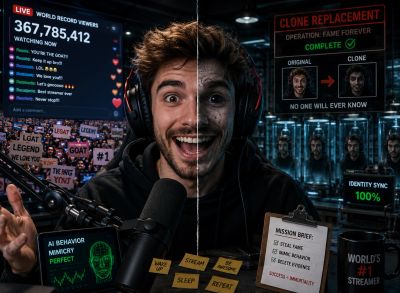
According to a highly suspicious folder discovered beside a broken ring light, the world’s biggest online personality was allegedly cloned during a private “creator wellness retreat” several months ago.
The original streamer reportedly entered the building for a facial treatment, a motivational seminar, and a free energy drink.
He was never seen leaving.
The next evening, his livestream began exactly on time.
He smiled at the camera, welcomed 300 million viewers, thanked his sponsors, screamed at a loading screen, accidentally knocked over a chair, and promised to reveal something “absolutely insane” after the next advertisement.
Nobody suspected a thing.
The Perfect Replacement
The alleged clone, identified in secret laboratory documents as Influencer Unit 2.0, was reportedly designed to imitate every detail of the original streamer.
It learned his laugh, his facial expressions, his favorite jokes, his gaming habits, and the precise angle at which he points toward the subscribe button.
Scientists also programmed the clone to say phrases such as:
“This is the craziest thing that has ever happened.”
“You guys are not ready for this.”
“Do not try this at home.”
“Thank you for the 500 gifted subscriptions.”
The clone was reportedly tested for several weeks inside a hidden content laboratory equipped with cameras, microphones, gaming chairs, artificial fan messages, and a machine capable of producing unlimited reaction faces.
The project was declared successful when the clone watched a completely ordinary sandwich being made and shouted, “This changes everything!”
Fans Noticed Small Differences
Although most viewers remain unaware of the replacement, several longtime fans have reported unusual behavior.
One viewer claimed the streamer blinked only twice during an eleven-hour broadcast.
Another said he drank from an empty cup for nearly three hours.
A third fan became suspicious after the streamer thanked the same sponsor 47 times in one minute while staring directly into the camera without moving.
The most disturbing moment happened during a late-night livestream when the streamer suddenly froze.
For seven seconds, he remained completely motionless.
His eyes turned toward the ceiling.
A faint mechanical voice could be heard saying:
“Personality update complete.”
The streamer then smiled and continued playing as if nothing had happened.
The clip was immediately deleted, re-uploaded, edited into a dance remix, transformed into a meme, and forgotten by lunchtime.
The Original May Still Be Alive
Anonymous sources claim the real streamer is being held somewhere beneath the content studio in a luxury containment room.
The room reportedly includes a bed, a mini refrigerator, a gaming console, and a television showing an endless replay of his clone’s livestream.
According to one security guard, the original streamer has attempted to escape several times.
His first attempt failed because he stopped to read the live comments.
His second attempt failed because he found a better camera angle.
His third attempt nearly succeeded, but he accidentally began filming an escape challenge and waited for the countdown to finish.
Laboratory employees allegedly refer to him as “The Offline One.”
Why Replace Him?
Experts believe the cloning operation may have been created to solve the greatest problem in livestreaming: human beings eventually become tired.
Real creators need sleep, food, privacy, vacations, and occasional moments when they are not selling limited-edition merchandise.
A clone needs none of these things.
Influencer Unit 2.0 can livestream 24 hours a day, seven days a week. It never becomes exhausted, never complains about the algorithm, and never forgets to remind viewers that the merchandise shop closes at midnight.
The clone can also react to thousands of videos simultaneously.
According to leaked documents, future models may be able to host livestreams in multiple languages, attend several award shows at once, and apologize for controversies before they happen.
Nobody Wants to Know the Truth
The most frightening part of the story is not that the world’s biggest streamer may have been replaced.
It is that the audience may not care.
When one fan was shown evidence of the cloning laboratory, he shrugged and asked whether the clone would still upload every day.
Another viewer said, “As long as the content is good, I do not see the problem.”
A third fan immediately purchased a clone-themed hoodie for $89.99.
Online experts attempted to warn the public, but their videos received fewer views than a clip of the streamer opening a box containing another smaller box.
Within hours, the clone replacement theory became a trending challenge.
Thousands of creators began pretending to malfunction on camera in hopes of gaining followers.
The real evidence disappeared beneath reaction videos, conspiracy threads, sponsored opinions, and advertisements for artificial intelligence courses.
A New Generation of Streamers
Documents suggest that Influencer Unit 2.0 may not be the only clone currently operating online.
Several major creators have recently displayed suspicious behavior, including repeating the same joke, promoting identical products, and making the exact same shocked face in every thumbnail.
Scientists deny that this proves anything.
They say real humans are perfectly capable of behaving like that without assistance.
However, a hidden facility believed to be connected to the project contains hundreds of glass chambers.
Each chamber holds a sleeping figure wearing headphones.
Some resemble gamers.
Others resemble lifestyle influencers, prank creators, motivational speakers, and people who review expensive bottles of water.
Above the facility entrance, a digital sign reads:
CONTENT MUST NEVER STOP.
The Livestream Continues
Last night, the world’s biggest streamer appeared online for another record-breaking broadcast.
More than 400 million people watched.
He laughed, shouted, thanked his viewers, and announced that tomorrow’s livestream would feature the most important reveal in internet history.
For a brief moment, the lights behind him flickered.
Several human-shaped figures could be seen standing inside glass tubes.
The streamer slowly turned toward them.
His smile disappeared.
Then he looked back at the camera and said:
“Do not worry about that.”
The chat exploded with laughing emojis.
Nobody asked another question.
And somewhere beneath the studio, the original streamer continued knocking on a locked metal door while his replacement broke another world record.
Are we watching people—or are we only watching content?
Aliens Save the World Cup Final by Delivering Emergency Tissues to Crying England Fans
LONDON — A potentially catastrophic national shortage of tissues was avoided Sunday evening after a squad of unusually polite aliens arrived in England during the final minutes of the World Cup final.
The extraterrestrial visitors reportedly landed outside a crowded London pub moments after England conceded a devastating goal, causing thousands of football fans to simultaneously place their hands over their faces and whisper, “Not again.”
Within seconds, the aliens entered the building carrying large boxes labeled Galactic Comfort Tissues: Soft, Strong and Universally Approved.
Witnesses described the rescue operation as organized, efficient and emotionally confusing.
“They came through the door wearing silver suits and carrying tissues like they had trained for this their entire lives,” said lifelong England supporter Nigel Butterfield.
“One of them put its hand on my shoulder and told me football pain is temporary, but interplanetary friendship is forever.”
Nigel then reportedly cried even harder.
An Emergency Visible from Space
According to alien mission commander Zorp-12, the emotional reaction from England supporters was powerful enough to be detected by satellites orbiting Jupiter.
“Our sensors identified an enormous cloud of sadness rising over the British Isles,” Zorp-12 explained through a translation device.
“At first, we believed Earth had suffered a major planetary disaster.”
The aliens quickly changed course and prepared for an emergency landing.
“Then we reviewed the television broadcast and discovered that it was simply football,” Zorp-12 said. “However, the level of suffering remained extremely impressive.”
Alien officials said the mission was upgraded from a standard observation flight to a Level Seven Emotional Hydration Emergency after cameras showed supporters crying into scarves, sleeves, pizza boxes and, in one case, a decorative Union Jack curtain.
The Galactic Tissue Distribution Program
The aliens immediately created several distribution stations across England.
Large tissue supplies were delivered to pubs, homes, public squares and any location where someone could be heard saying, “We were so close.”
Special teams were deployed to assist supporters who had been repeating the phrase “It’s coming home” for several weeks.
“We did not understand what was coming home,” said alien volunteer Plee-Ploo.
“We assumed it was a lost spaceship, an important leader or perhaps a very large delivery.”
After studying English football history, the aliens concluded that “it” may still be searching for the correct address.
The extraterrestrials reportedly offered to use advanced navigation technology to locate the missing trophy, but FIFA officials politely declined.
Tea, Tissues and Tactical Analysis
As the evening continued, the aliens sat with supporters and attempted to understand the rules of football.
Several aliens became confused by offside decisions, injury time and the tradition of blaming the referee.
One alien was seen using a holographic tactical display to explain how England could have defended the final goal.
The presentation lasted three minutes before an emotional fan unplugged the device and said, “Too soon.”
Another alien tried to comfort the crowd by explaining that Earth is only one planet among billions and that football results are insignificant compared with the mysteries of the universe.
The alien was immediately asked to leave the pub.
“Clearly, they still have much to learn about British culture,” said local bartender Susan Pickles.
“You cannot tell people the World Cup is insignificant while they are wearing face paint and holding seven empty tea cups.”
A Message of Hope from Beyond the Stars
Despite the sadness, the alien visitors praised England fans for their loyalty, passion and ability to continue believing after decades of emotional damage.
“Our civilization has existed for nine million years,” said Commander Zorp-12.
“We have survived meteor storms, black holes and three intergalactic tax audits. But we have never witnessed hope as powerful as an England fan before a major tournament.”
Before departing, the aliens promised to return for the next World Cup with stronger tissues, emergency tea supplies and a device capable of muting television commentators.
They also left behind a giant message projected above London:
“DO NOT CRY. IT IS ONLY FOOTBALL. PROBABLY.”
Fans appreciated the gesture but immediately began discussing team selection, missed opportunities and whether the manager should resign.
Preparations Have Already Begun
British authorities have now announced plans to create a permanent partnership with the alien tissue squad.
Under the proposed agreement, emergency spacecraft would remain stationed near Earth during all future international tournaments involving England.
Tissue reserves would be increased before penalty shootouts, while alien emotional-support specialists would receive training in phrases such as:
“We go again.”
“At least we made the final.”
“The referee ruined everything.”
“Next tournament will be different.”
Meanwhile, shops across England have already begun selling unofficial Galactic Comfort Tissues.
Demand is expected to remain high until supporters regain hope, which experts predict will happen approximately three weeks before the next major competition.
Editor’s Note: This article is fictional satire created for humor and entertainment.
No aliens, football supporters or emergency tissue supplies were harmed during its production.

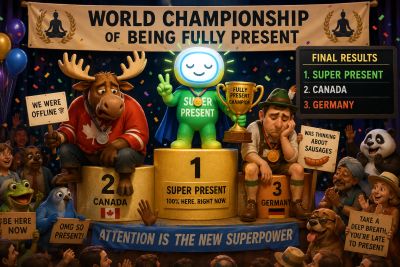
Super Present Defeats Canada and Germany at World Championship of Being Fully Present
In a stunning upset that nobody saw coming because they were checking their phones, the newly formed nation of Super Present has defeated Canada and Germany to become the most fully present country on Earth.
The historic victory took place during the first World Championship of Being Fully Present, an international competition designed to measure which country could remain focused on the current moment without worrying about yesterday, planning tomorrow, or secretly opening another browser tab.
Canada entered the tournament as the early favorite. Its team arrived calm, polite and carrying reusable water bottles. Germany was also considered a major contender because of its discipline, organization and carefully laminated mindfulness schedule.
However, both nations were completely overwhelmed by the mysterious newcomers from Super Present, a country that apparently exists only in the exact moment you become aware of it.
Super Present earned a perfect score after its entire team remained focused for twelve consecutive minutes without checking a notification, discussing the future or remembering something embarrassing from 2009.
Judges described the performance as “almost supernatural.”
Canada Loses Focus After Apologizing
Canada’s problems began during the opening meditation round.
The Canadian team was performing well until one participant accidentally breathed too loudly and apologized to everyone in the stadium.
This caused another Canadian to apologize for accepting the apology too quickly. Within minutes, the entire team was trapped in a national chain of politeness.
“We were present at first,” said Canadian team captain Moose McKenzie. “But then I started wondering whether everyone was comfortable, and after that I remembered I forgot to answer an email.”
Canada eventually finished in second place after losing points for thinking about tomorrow’s weather.
Officials said the Canadian team remained positive despite the defeat and congratulated Super Present approximately forty-seven times.
Germany Distracted by Perfect Organization
Germany entered the final round with the most advanced concentration strategy in the competition.
Its team had created a detailed 320-page presence manual, complete with breathing diagrams, emergency silence procedures and a color-coded timetable explaining exactly when competitors should stop thinking about the timetable.
Unfortunately, the plan became too efficient.
During the final challenge, Germany’s lead competitor suddenly realized that the meditation cushions were positioned 1.7 centimeters outside the approved formation.
He immediately stopped being present and began reorganizing the entire stage.
“We were thinking about the moment,” explained German coach Hans Jetzt. “But then we became concerned that the moment had not been properly scheduled.”
Germany finished in third place after several team members admitted they were thinking about sausages.
The Rise of Super Present
Very little is known about the winning nation.
Super Present has no official capital, no permanent borders and no national history because its citizens insist that the past is no longer happening.
Its flag is reportedly invisible unless you stop trying to see it.
The national anthem consists of one deep breath followed by several seconds of comfortable silence.
Citizens of Super Present do not carry watches. They claim the correct time is always “now,” although this has caused significant difficulties at airports.
The country’s president, who is officially known only as “This Person Right Here,” accepted the trophy without delivering a long speech.
Instead, the president looked at the audience, smiled and said:
“We are here.”
The crowd remained silent for several seconds before realizing the speech was over.
It later received a standing ovation.
Phones Confiscated at the Entrance
The championship introduced strict rules to prevent technological distraction.
All spectators were required to place their phones in a locked box before entering the stadium.
This caused immediate panic.
Several audience members were seen repeatedly touching their empty pockets.
One man attempted to scroll through a sandwich. Another asked a nearby plant whether it had Wi-Fi.
After approximately twenty minutes, however, the crowd began noticing unusual things around them, including other human beings, the ceiling and the fact that birds make sounds.
“It was terrifying at first,” said one spectator. “Then I spoke to my wife. She seems interesting.”
Organizers said the no-phone policy may return next year, although security officials have requested additional emotional support training.
A New Global Superpower
Experts believe Super Present’s victory could change international politics.
Governments around the world are reportedly considering the creation of Ministries of Attention to help citizens concentrate on one crisis at a time.
Canada has promised to improve its performance by launching a national program called “Sorry, We Were Somewhere Else.”
Germany has announced plans to build the world’s most accurate mindfulness clock.
Meanwhile, Super Present has rejected all requests for a five-year strategy.
“We do not have a five-year plan,” said a government representative. “We have this cup of tea.”
Economic analysts remain confused by the country’s financial system, which does not recognize future profits, past losses or limited-time offers.
Super Present’s currency is known as the Now, although every coin disappears the moment someone tries to save it.
The Real Meaning of the Competition
Despite the comedy and international rivalry, organizers said the event carried a serious message.
Modern life has made attention one of the world’s most valuable resources.
People are constantly pulled between notifications, memories, worries, headlines, advertising and endless digital entertainment.
The championship was created to remind people that being present does not require becoming a monk, moving to a mountain or deleting every app.
Sometimes it simply means listening to the person in front of you, noticing where you are and allowing one moment to exist without immediately trying to record it.
Canada may have lost first place.
Germany may have lost track of the meditation schedule.
But for a few minutes, the entire stadium stopped scrolling and looked up.
That may have been the real victory.
Editor’s Note: This article is satire.
Super Present is a fictional country, although applications for citizenship are accepted every time you take a deep breath and remember where you are.
The Courage Floor: How Levegarism Could Build a Society Where Nobody Is Abandoned Below Fear
Modern society often asks people to become courageous while surrounding them with insecurity.
We tell individuals to believe in themselves while they worry about housing, food, healthcare, employment, debt, isolation and social rejection.
We praise resilience while maintaining systems that continuously produce fear.
We encourage people to take risks, speak honestly and follow their purpose, yet one mistake can still cost them their income, reputation or place in society.
Levegarism proposes a different starting point.
Instead of treating courage as a rare personal achievement, Levegarism would make courage the guaranteed social baseline.
It would create a foundation beneath every person strong enough to prevent shame, guilt, apathy, grief, fear, uncontrolled desire, anger and defensive pride from becoming permanent ways of life.
This foundation can be called the Courage Floor.
The Courage Floor does not promise that people will never feel afraid, angry, ashamed or sad.
These emotions are part of being human.
The goal is not to erase them from the human nervous system.
The goal is to ensure that nobody remains trapped inside them because society refused to provide security, dignity, support, opportunity or a path forward.
In a Levegarist society, lower emotional states would become temporary signals that activate support and transformation.
Nobody would be abandoned below courage.
What Is Levegarism?
Levegarism is a post-capitalist social model based on using humanity’s collective leverage—technology, automation, knowledge, cooperation, natural resources and public institutions—to increase freedom and human potential.
The central question of Levegarism is not simply:
“How much profit can this system produce?”
It asks:
“How much positive human capacity can this system create?”
Technology would no longer be used mainly to reduce labour costs while leaving displaced workers insecure.
Automation would reduce unnecessary work while sharing the benefits of greater productivity.
Economic success would not be measured only through production and consumption.
It would also be measured through health, education, environmental stability, available time, community trust, emotional well-being and meaningful participation.
The purpose of society would be to help every person develop enough stability and agency to contribute according to their abilities.
Levegarism therefore begins with a fundamental promise:
Every human being deserves enough security, dignity and opportunity to act from courage rather than desperation.
Why Courage Must Become the Baseline
Courage is the point where a person begins to believe that change is possible.
Below courage, people often feel controlled by circumstances.
They may believe they are powerless, unworthy, unsafe or incapable of improving their situation.
Above courage, a person begins to participate consciously in life.
They can learn, take responsibility, make decisions, cooperate with others and move toward greater awareness.
Courage does not mean the absence of fear. It means having enough safety, support and personal agency to move forward despite fear.
A society built on courage would not require everyone to become fearless. It would make sure fear was no longer the main tool used to control behaviour.
People would not work primarily because they fear homelessness.
Students would not learn primarily because they fear humiliation.
Citizens would not cooperate primarily because they fear punishment.
Consumers would not buy products primarily because advertising made them feel inadequate.
Voters would not support leaders primarily because they were frightened of another group.
The Courage Floor would weaken these systems by guaranteeing that every person has a basic level of security and social power.
The Guaranteed Social Foundation
To establish courage as a baseline, Levegarism would guarantee the conditions that make courageous action possible.
Every person would have access to safe housing, nutritious food, clean water, healthcare, education, communication technology, transportation and basic energy.
A guaranteed stability income or social dividend would ensure that people could survive periods of unemployment, illness, retraining, caregiving or personal transition.
This would not mean that everyone receives unlimited wealth or that personal effort becomes meaningless.
It would mean that no person’s survival could be used as a weapon against them.
A worker could report corruption without immediately fearing homelessness.
A person could leave an abusive environment without losing access to shelter.
An inventor could develop an idea without risking complete financial collapse.
A parent could care for a child without being treated as economically useless.
A student could choose a meaningful profession instead of being forced into the fastest available source of income.
When basic survival is secure, courage can become practical rather than inspirational.
Transforming Shame Into Human Dignity
Shame tells a person, “There is something fundamentally wrong with me.”
A society that uses humiliation as motivation produces silence, secrecy and emotional paralysis.
People become afraid to admit mistakes because they believe failure will result in rejection.
Levegarism would begin with unconditional human dignity.
This does not mean that every action is acceptable. It means that human worth is never cancelled by failure.
Schools would stop publicly humiliating struggling students. Justice systems would separate accountability from permanent social exclusion.
Workplaces would create pathways for correction rather than relying only on punishment.
A person who makes a mistake would be encouraged to understand it, repair the harm and return to meaningful participation.
The transformation would be:
Shame becomes unconditional human dignity.
The message would change from “You are broken” to “You still belong, and you are capable of growth.”
Transforming Guilt Into Accountability and Repair
Healthy guilt can tell us that our actions violated our values or harmed another person.
But guilt becomes destructive when there is no pathway toward repair.
Levegarism would replace endless condemnation with restorative accountability.
When harm occurs, the central questions would be:
What happened?
Who was affected?
What responsibility must be accepted?
What repair is possible?
What must change to prevent repetition?
Forgiveness would not be forced, and serious harm would still require protection and consequences.
However, the goal of justice would be transformation wherever possible—not simply revenge.
People would be expected to face the results of their actions, participate in repair and demonstrate change.
The transformation would be:
Guilt becomes accountability and repair.
Transforming Apathy Into Support and Participation
Apathy often appears when people believe nothing they do will make a difference.
When institutions ignore citizens, workplaces treat employees as replaceable and economic systems concentrate power beyond public reach, withdrawal becomes understandable.
Levegarism would respond to apathy by restoring visible influence.
Communities would use participatory budgeting, local assemblies and citizen-designed projects.
People would be able to see how their decisions affected their neighbourhoods.
Every person would have access to meaningful roles, including caregiving, mentoring, ecological restoration, cultural work, community safety, education and public problem-solving.
Participation would not be limited to conventional employment.
The person who supports an elderly neighbour, restores a public garden, teaches a practical skill or helps resolve a community conflict is contributing real value.
The transformation would be:
Apathy becomes support and participation.
The individual would no longer hear, “Try harder.”
They would hear, “You matter, and there is a place where your effort can have an effect.”
Transforming Grief Into Care and Renewed Meaning
Grief cannot and should not be eliminated.
Loss is part of life. People lose loved ones, relationships, homes, identities, opportunities and visions of the future.
The problem is not grief itself. The problem is forcing people to process grief alone while continuing to perform as if nothing happened.
A Levegarist society would recognize grief as a legitimate social condition.
People would receive time, community care, counselling and practical support after major losses.
Workplaces and schools would create compassionate reintegration rather than expecting immediate productivity.
Communities would preserve memory through ceremonies, art, storytelling and public spaces.
The purpose would not be to rush a grieving person back to happiness.
It would be to help them carry loss without losing their connection to life.
The transformation would be:
Grief becomes care and renewed meaning.
Transforming Fear Into Preparation and Agency
Fear is often useful. It alerts us to danger and encourages preparation.
But chronic fear destroys agency. A person who feels permanently unsafe may become submissive, aggressive, suspicious or easily manipulated.
Modern institutions frequently profit from this condition.
Political campaigns amplify fear. News platforms repeat danger.
Advertising creates insecurity. Employers use financial vulnerability to demand obedience.
Levegarism would reduce fear by replacing uncertainty with trustworthy information, real preparation and meaningful choices.
Public institutions would communicate risks without exaggeration.
Emergency planning would be available to every community.
Citizens would have transparent access to the information used in major decisions.
Healthcare, housing and income security would prevent ordinary setbacks from becoming personal catastrophes.
The transformation would be:
Fear becomes preparation and agency.
People would still recognize danger, but they would have the knowledge and resources to respond.
Transforming Desire Into Purpose and Enoughness
Desire helps people create, explore and improve their lives.
But desire becomes destructive when society continuously manufactures a feeling of insufficiency.
Modern consumer systems often tell people they are not attractive enough, successful enough, young enough, wealthy enough or important enough.
Products are then offered as temporary solutions to the insecurity the system helped create.
Levegarism would distinguish between authentic aspiration and manufactured craving.
People would be encouraged to ask:
Do I genuinely need this?
Will it improve my life?
Does it reflect my values?
What environmental and human costs were involved?
Could access replace ownership?
Education would teach emotional and media literacy so that people could recognize manipulation.
The transformation would be:
Desire becomes purpose and enoughness.
Enoughness would not mean abandoning ambition.
It would mean being able to pursue growth without believing that one’s value depends on endless acquisition.
Transforming Anger Into Justice and Boundaries
Anger is often a response to violation.
It can signal exploitation, disrespect, inequality or the crossing of an important boundary.
Suppressing anger does not create peace. It often allows injustice to continue until the pressure becomes destructive.
Levegarism would give anger legitimate channels.
Workers could organize without retaliation.
Citizens could challenge institutions through protected public processes.
Whistleblowers would receive strong legal protection. Communities could demand investigations and policy changes.
Conflict-resolution systems would help people communicate boundaries before disagreements escalate.
The transformation would be:
Anger becomes justice and boundaries.
The goal would not be to make everyone passive. It would be to turn emotional energy into intelligent correction.
Transforming Pride Into Healthy Dignity
Pride can protect a person from shame, but it can also become superiority, defensiveness and domination.
When people believe their value depends on being better than others, cooperation becomes difficult. Every disagreement feels like an attack on identity.
Levegarism would replace status based on domination with recognition based on contribution.
The most respected people would not automatically be those who accumulate the most money, attention or possessions.
Social recognition would increasingly go to people who create capacity for others: teachers, caregivers, builders, healers, inventors, organisers, protectors, artists, mediators and ecological restorers.
The transformation would be:
Pride becomes healthy dignity.
Healthy dignity says, “I have value, and so do you.”
Education Above the Courage Floor
A courage-based society would begin in childhood.
Schools would teach emotional regulation, critical thinking, conflict resolution, cooperation, civic participation and recovery from failure.
Students would learn how to admit mistakes without collapsing into shame.
They would practice respectfully challenging ideas and authority.
They would learn how to identify propaganda, manipulation, misinformation and fear-based persuasion.
Success would no longer be measured only by memorization and competition.
Education would also value curiosity, courage, reliability, creativity, emotional maturity and contribution to the group.
Mistakes would be treated as information.
Asking for help would be treated as intelligence.
Changing one’s mind after receiving better evidence would be treated as strength.
The purpose of education would not simply be to prepare children for employment.
It would prepare them to remain above the Courage Floor while helping others return to it.
Work Without Fear
Most people spend a large part of their lives working, yet many workplaces are governed by fear.
Employees may be afraid to report problems, disagree with managers, admit uncertainty or experiment with new ideas.
Levegarist workplaces would be organised around psychological safety, shared ownership and transparent decision-making.
Workers would participate in major decisions affecting their livelihoods. Productivity gains from automation would be shared through shorter working hours, better compensation, public dividends or expanded services.
Technology would be evaluated according to whether it reduces unnecessary labour while preserving dignity and stability.
The purpose of automation would not be to make human beings disposable.
It would free people from repetitive and dangerous work while expanding their ability to contribute creatively.
A courageous workplace would allow someone to say:
“I made a mistake.”
“I see a serious problem.”
“I disagree with this decision.”
“I have a better idea.”
“I need support.”
These statements would be treated as opportunities for learning rather than acts of disloyalty.
Media That Informs Instead of Paralysing
A society cannot remain above courage if its information environment continuously produces panic and outrage.
Levegarist media would still expose corruption, violence, danger and injustice. Honest reporting is essential.
But every major report would also provide context, possible responses and examples of effective solutions.
Journalism would ask:
What happened?
Why did it happen?
Who benefits?
Who is harmed?
What can citizens do?
What institutional response is required?
Where has a similar problem been successfully addressed?
Digital platforms would be required to make recommendation systems more transparent. Users could choose whether their feeds emphasised local news, education, constructive debate, creativity or public participation.
Outrage would no longer be the default business model.
Fear could alert society to danger, but it could not be allowed to become society’s permanent emotional climate.
Government Above the Courage Floor
Levegarist governance would be judged by whether it increases agency.
Every major policy could be evaluated through a Courage Test:
Does the policy depend on fear or humiliation?
Does it increase people’s ability to make meaningful decisions?
Does it protect dignity?
Does it distribute power or concentrate it?
Does it address the cause of a problem or only punish its symptoms?
Does it help future generations become more secure and capable?
Citizens’ assemblies, participatory budgeting and transparent public data would make political participation more direct.
Leaders would be expected to admit uncertainty, acknowledge mistakes and correct policies when evidence changed.
Pretending to be infallible would no longer be treated as strength.
The courage to tell the truth, especially when it is inconvenient, would become one of the highest standards of leadership.
The Automatic Return to Courage
The Courage Floor would operate through a simple social protocol.
Whenever a person or community begins falling into a lower condition, institutions would respond by asking six questions:
What is happening?
Is there an immediate threat?
What need is unmet?
What support will restore stability?
What choice will restore agency?
What courageous next step is possible?
This protocol would turn emotions into pathways:
Fear becomes information, preparation and action.
Anger becomes boundaries and justice.
Guilt becomes responsibility and repair.
Grief becomes support and renewed meaning.
Apathy becomes participation.
Shame becomes dignity.
The goal is not forced positivity.
A person would never be told to smile while experiencing injustice, grief or danger.
The goal is to ensure that every difficult emotion leads somewhere.
What Exists Above the Courage Floor?
Once courage becomes stable, higher levels of development become possible.
Courage creates the ability to face reality.
Neutrality brings flexibility and reduces the need to control everything.
Willingness creates openness to learning and participation.
Acceptance strengthens responsibility.
Reason allows complex problems to be understood.
Love expands concern beyond the individual self.
Joy appears when contribution and existence are experienced as meaningful.
Peace develops when inner conflict and unnecessary resistance decrease.
Enlightenment represents the highest aspiration: unity, truth and identification with something greater than the isolated ego.
Society cannot force people into these higher states.
It can only create conditions that make development possible.
The role of Levegarism is not to manufacture enlightened citizens.
It is to stop manufacturing fear.
A New Social Promise
The Courage Floor can be summarized through one promise:
No one stays below courage. Every person, every time, is offered a path back to dignity, agency and participation.
This does not mean nobody will struggle.
It means struggle will no longer result in abandonment.
Nobody should remain trapped in shame because they made a mistake.
Nobody should remain trapped in guilt when repair is possible.
Nobody should remain trapped in apathy because institutions refuse to listen.
Nobody should face grief without care.
Nobody should remain controlled by fear because basic survival is insecure.
Nobody should be manipulated through endless manufactured desire.
Nobody should need uncontrolled anger to make injustice visible.
Nobody should depend on superiority to experience dignity.
Levegarism would use humanity’s greatest forms of leverage—knowledge, technology, community, compassion and cooperation—to build a foundation strong enough for courage to become ordinary.
The success of society would no longer be measured only by how high a few people can rise.
It would be measured by how reliably everyone is protected from falling beneath the floor.
That is the deeper meaning of the Courage Floor.
It is not simply a diagram of consciousness.
It is a design requirement for civilisation.
Secure needs. Restore dignity. Create real choices. Encourage meaningful contribution.
Build a shared future.
And when someone falls, society does not judge them from above.
It reaches down, restores their agency and helps them stand again.
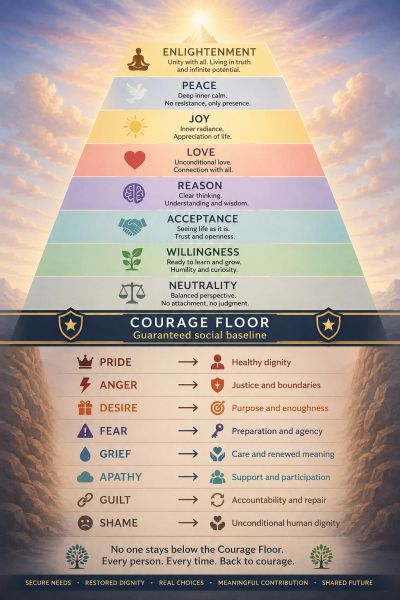
Half-Alien Man Can Travel Across the Universe but Still Can’t Leave His Negative Friends
An unhappy hybrid living in England has discovered that escaping Earth’s atmosphere is easier than telling his mates he wants something better.
ENGLAND — A half-human, half-alien man has spent another rainy afternoon outside his local pub, wondering why he possesses the ability to communicate with distant civilizations but cannot tell three people he no longer wants to spend every Saturday complaining.
The man, known locally as Gary and elsewhere in the galaxy as Zorath the Unrestricted, reportedly arrived on Earth with extraordinary abilities, limitless curiosity, and a powerful sense of purpose.
After several years with his current friendship group, he now describes his main ambition as “getting through the week.”
“I used to dream about exploring new worlds, building something meaningful, and meeting people who were excited to be alive,” Gary told reporters, wiping rain from his human eye.
“Then Darren said that sounded a bit much.”
According to witnesses, Gary’s friends have developed an impressive system for discouraging any activity that might improve his life.
When he mentioned starting a business, they reminded him that businesses fail. When he suggested moving somewhere sunny, they warned him about insects.
When he considered joining an intergalactic creative community, one friend asked whether he thought he was better than everyone.
“I hadn’t even finished saying ‘creative,’” Gary said.
Their objections became particularly confusing after Gary parked a fully operational spacecraft beside the pub.
The vessel offers unlimited clean energy, automatic translation, and access to thousands of peaceful worlds.
Through its open doorway, visitors can see a tropical coastline where the weather is pleasant and nobody has spent the last nine years discussing the same parking dispute.
His friends remain unconvinced.
“Probably expensive over there,” said Darren, despite being informed that the destination has no money.
“Sounds suspicious,” he added.
Another friend, Keith, questioned the spacecraft’s reliability while standing beside a car that has required four jump-starts since Tuesday.
“You can’t just get in something and expect it to take you somewhere,” Keith explained.
Gary briefly looked at the car, then decided he did not have the energy.
The hybrid admits that his friends were not always so discouraging.
They welcomed him when he first arrived, helped him understand the bus system, and assured him that having one enormous black eye would barely attract attention on a Friday night.
For a lonely newcomer, that kindness mattered.
“They were there when I needed company,” Gary said. “I think I confused being grateful for that with owing them the rest of my life.”
Over time, however, every hopeful conversation became a small public trial.
His ideas were mocked before they were understood. His successes were treated as luck. Any attempt to change was greeted with the accusation that he was “not himself lately.”
The version of himself they preferred, Gary noticed, was always the one sitting quietly beside them.
An onboard diagnostic scan recently confirmed that his spaceship was ready for departure.
Its engines were functioning perfectly.
The navigation system had identified a safe route.
Weather conditions were acceptable.
Under “remaining obstacle,” the computer displayed:
“YOU ARE WORRIED DARREN WILL TAKE THE MICK.”
Gary immediately closed the screen.
“That felt unnecessarily personal,” he said.
His mother, speaking from a distant star system, has struggled to understand the delay.
“She keeps asking whether I’m being held captive,” Gary explained. “I say no, and then she asks why I’m still here. That’s usually when I pretend the signal is breaking up.”
The turning point came when Gary announced that he had been accepted into a programme helping restore damaged planets.
It was work he had dreamed of doing since childhood.
His friends asked whether the position came with free drinks.
When he said no, they changed the subject.
“For once, I didn’t argue,” Gary said. “I just noticed that I’d told them something that made me happy, and somehow I was leaving the conversation embarrassed.”
That evening, he packed a small suitcase.
He did not prepare a dramatic speech or declare his friends terrible people. He understood that they could continue enjoying their lives as they were. He simply wanted permission to enjoy a different one—and was beginning to accept that they might never give it.
Outside the pub, Darren watched him approach the spacecraft.
“You’ve changed,” he called.
Gary paused at the doorway.
“Yes,” he said. “I was hoping someone would notice.”
He invited them to visit if they ever felt curious. Then he stepped inside, placed his suitcase beside the pilot’s seat, and entered the coordinates with trembling hands.
He was still frightened. Leaving had not magically turned him into a fearless intergalactic adventurer.
But for the first time in years, he was frightened while doing something he actually wanted to do.
As the spacecraft rose above the rooftops, Keith shook his head.
“He’ll be back when he misses this.”
At that exact moment, rainwater ran off the pub umbrella and directly into his pint.
Gary’s first message arrived several hours later: a photograph of a golden beach, a workshop overlooking the ocean, and two new acquaintances asking him what he wanted to create.
Darren replied immediately.
“Looks boring.”
For the first time in his life, Gary let the group chat carry on without him.
Fictional satire.