🍁👽 Canada's Lumber Industry Celebrates Its Own Obsolescence With First Intergalactic Log-Rolling Championship
By the Are We Ready? News Network
In what experts are calling "the most Canadian reaction in recorded history," Canada's largest lumber companies have officially celebrated the end of their dependence on wood.
The celebration came after a delegation of friendly extraterrestrials unveiled a revolutionary manufacturing technology capable of replacing virtually every material traditionally derived from trees.
Instead of protesting, filing lawsuits, or launching public awareness campaigns, industry executives reportedly responded with a simple question:
"So... who's up for a log-rolling championship?"
Within weeks, thousands gathered along rivers across British Columbia, Quebec, Ontario, and New Brunswick for the inaugural Intergalactic River Log-Rolling Championship, featuring lumberjacks, engineers, aliens, and one highly competitive moose.
The Technology
According to alien representatives, the new material—known unofficially as GalaxyWood™—can be produced from atmospheric carbon, agricultural waste, recycled plastics, algae, and even captured industrial emissions.
The material reportedly offers:
- Greater strength than hardwood
- Resistance to fire
- Resistance to rot
- Zero need for cutting trees
- Full recyclability
- Carbon-negative manufacturing
One alien engineer explained:
"We were confused why humans kept chopping down giant oxygen-producing life forms to build patio furniture."
Scientists immediately agreed this was a fair point.
So What Happens To Lumber Companies?
Far from disappearing, Canada's lumber sector may actually become larger and more profitable than ever.
1. Material Manufacturing
Instead of harvesting trees, companies could manufacture advanced materials directly.
Current sawmills become:
- Material fabrication plants
- Carbon capture centers
- Recycling hubs
- Construction material suppliers
Many facilities already possess the logistics, transportation networks, warehouses, and skilled workforce needed for the transition.
2. Forest Stewardship
Canada possesses one of the largest forest ecosystems on Earth.
Without pressure to harvest wood, companies could pivot toward:
- Forest management
- Wildfire prevention
- Biodiversity restoration
- Carbon-credit generation
- Eco-tourism
Industry analysts estimate protected forests could become one of Canada's most valuable long-term assets.
3. Advanced Construction
The new material can reportedly be:
- 3D printed
- Molded
- Recycled endlessly
- Produced locally
Entire homes may eventually be manufactured within days.
Industry leaders are already imagining:
- Affordable housing projects
- Disaster relief housing
- Arctic construction systems
- Floating ocean platforms
4. Carbon Mining
One unexpected opportunity involves carbon itself.
Instead of extracting lumber from forests, companies could harvest carbon emissions from:
- Factories
- Data centers
- Transportation networks
The captured carbon becomes raw material for new products.
One CEO described the concept as:
"It's basically logging the atmosphere."
The New Gold Rush
Economic observers believe Canada could become one of the world's largest exporters of advanced sustainable materials.
Potential products include:
- Furniture
- Building materials
- Shipping containers
- Vehicle components
- Spacecraft interiors
- Sporting equipment
- Infrastructure systems
One analyst estimated that every industry currently dependent on wood, plastic, concrete, or steel could become a future customer.
The Championship
The celebration itself featured teams from across Canada competing on floating logs while alien referees attempted to understand why humans found this entertaining.
Highlights included:
- Team Quebec's synchronized double-spin maneuver
- British Columbia's controversial anti-gravity boots
- An alien contestant who accidentally rolled across the entire river without falling
- A moose that reached the finals
The winning team received the coveted Golden Log Trophy, made entirely from the new wood-free material.
Looking Ahead
Industry leaders believe the future of forestry may involve fewer chainsaws and more engineers.
Forests would remain standing.
Wildlife would benefit.
Carbon emissions could fall.
And lumber companies could potentially earn more money than ever before.
As fireworks illuminated the river and competitors celebrated late into the night, one veteran lumberjack summarized the mood perfectly:
"The aliens replaced our wood, but they didn't replace our ability to have a good time."
Preparations are already underway for next year's championship.
Rumors suggest the event may include hover-logs, anti-gravity canoe races, and a new category known only as:
Extreme Competitive Canadian Politeness.

🏝️👽 Norway's Secret Cyber Festival Receives Unexpected Alien Reinforcements
Private Island, Somewhere in the North Atlantic — What was supposed to be a routine cybersecurity retreat for Norway's elite intelligence specialists has turned into what experts are calling "the most productive beach party in modern history."
According to highly questionable sources, members of Norway's top cyber units arrived on a classified tropical island last week expecting the usual agenda: threat briefings, coffee consumption, and PowerPoint presentations that would somehow last longer than winter.
Instead, they were greeted by a fleet of unidentified flying objects carrying instructors from the Canadian Army's rumored Extraterrestrial Advisory Division.
Witnesses report that the alien delegation arrived carrying glowing tablets, quantum networking equipment, and several coolers filled with maple syrup.
"We are here to help your cyber warriors evolve," announced General Zorp-7, a seven-foot-tall Canadian alien wearing sunglasses and a camouflage uniform.
The announcement was met with cautious optimism and approximately seventeen requests for Wi-Fi passwords.
The Curriculum
The week-long festival featured dozens of advanced training sessions.
Popular workshops included:
- How to Detect Interdimensional Phishing Attempts
- Advanced Firewall Barbecuing
- Quantum Coffee Optimization
- Social Engineering for Introverts
- Alien Encryption Using Telepathy
- Defending Against Time-Traveling Hackers
Participants reportedly earned experience points throughout the event.
Upon reaching Level 50, agents unlocked "Enhanced Suspicion."
At Level 75 they gained the ability to identify weak passwords from across the room.
Level 100 graduates reportedly gained the legendary skill known as "Knowing Exactly Why The Printer Isn't Working."
Scientists remain unable to explain this phenomenon.
The Famous Firewall BBQ
The highlight of the festival was the annual Firewall BBQ Championship.
Teams competed to prepare secure hamburgers while simultaneously defending their grills from simulated cyber attacks launched by interns disguised as seagulls.
One Norwegian team successfully blocked over 3,000 intrusion attempts while producing what judges described as "an excellent medium-rare steak."
The aliens awarded them a Golden Router trophy and a lifetime supply of encrypted hot sauce.
The SOC Shuffle
Every evening concluded with the famous SOC Shuffle Dance Tournament.
Security Operations Center specialists faced off against alien instructors in a series of increasingly complicated dance routines.
Observers claim several participants accidentally achieved temporary enlightenment after successfully completing the Advanced Intrusion Detection Tango.
One analyst reportedly discovered three zero-day vulnerabilities and inner peace during the same performance.
Mysterious New Technology
Perhaps the most controversial moment came during a presentation titled:
"Cybersecurity Beyond Space and Time."
Attendees were introduced to revolutionary concepts such as:
- Passwords longer than 12 characters
- Documentation that people actually read
- Meetings that finish on time
Many experts initially dismissed these ideas as science fiction.
International Reactions
Governments around the world are said to be monitoring the situation closely.
Several countries have reportedly begun planning their own cybersecurity festivals.
One unnamed official stated:
"If Norway starts producing Level 100 cyber agents trained by Canadian aliens, we're going to need a bigger budget."
Meanwhile, the Canadian government continues to deny the existence of any extraterrestrial military advisors.
The aliens, however, deny the existence of the Canadian government.
Looking Ahead
As the festival concluded, participants boarded helicopters, submarines, and several unidentified glowing objects before returning home.
Many described the experience as life-changing.
Others simply appreciated receiving a free beach towel that allegedly blocks malware.
Whether the event truly happened remains impossible to verify.
But one thing is certain:
Somewhere on a remote island, a group of highly trained cyber specialists are sipping encrypted coffee, watching the sunset, and preparing for next year's championship.
And if the rumors are true, the aliens have already reserved the BBQ pit.
Stay tuned for further developments.
Or don't.
The aliens probably already know what you're going to do.

🍁🔺 Project M.A.S.S.E. Reaches New Milestone: Fort Knox Gold Teleportation Trial Approved
OTTAWA, CANADA — In what officials are calling a "historic step forward for highly questionable science," the Canadian Space Agency's secret Pyramid Teleportation Division has reportedly begun preparations for its first large-scale international teleportation experiment.
Following months of ritualized quantum chanting inside rented Egyptian pyramids, researchers claim they have successfully teleported several hockey pucks, three pallets of maple syrup, and one very confused moose across vast distances.
The next phase is considerably more ambitious.
According to leaked documents stamped "SUPER DUPER SECRET," Canadian and American officials have agreed to conduct a bilateral demonstration involving a small portion of the gold reserves stored at Fort Knox.
The objective?
To instantly teleport several gold bars directly into the vaults of the Bank of Canada before teleporting them back moments later.
Officials insist the experiment is purely scientific.
"We definitely intend to return the gold," stated one anonymous project scientist while nervously adjusting a pyramid-shaped helmet. "Probably."
The operation, code-named Golden Maple Express, will use a combination of ancient geometry, quantum synchronization, and what insiders describe as "an unreasonable quantity of maple syrup."
Mission Control sources reveal the teleportation sequence requires:
- 24 synchronized physicists
- 8 pyramid alignment specialists
- 3 moose for calibration
- 1 emergency poutine reserve
- A playlist of motivational hockey highlights
The gold bars will reportedly travel through a temporary quantum corridor generated beneath the Great Pyramid.
Researchers believe the process could revolutionize international logistics.
Future applications include:
- Instant humanitarian aid delivery
- Teleporting construction materials
- Relocating hockey teams before away games
- Emergency poutine deployment during national crises
- Rapid transportation of extremely important beavers
Meanwhile, economists around the world remain skeptical.
One analyst noted that if the system works, central banks may eventually replace armored trucks with giant glowing portals guarded by geese.
The Bank of Canada has declined to comment directly but did confirm that several employees have recently attended seminars titled:
"How To Welcome Incoming Gold From Another Dimension."
As preparations continue, observers have reported unusual activity around the pyramids, including glowing maple leaf symbols visible from orbit and mysterious chants repeating:
"As above, so below... but preferably delivered before lunch."
Whether Project M.A.S.S.E. becomes the greatest transportation breakthrough in human history or simply the most expensive pyramid rental agreement ever signed remains to be seen.
For now, the world watches and waits as Canada attempts the impossible:
Teleporting Fort Knox gold without accidentally sending it to a Tim Hortons parking lot.

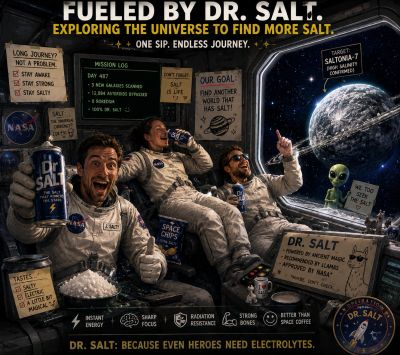
🚀🌄 NASA's Secret Machu Picchu Rental Reveals "Dr. Salt" Energy Drink
MACHU PICCHU, PERU — In what may become the most unusual chapter in aerospace history, leaked documents suggest that NASA quietly rented the ancient ruins of Machu Picchu for a highly classified research program known internally as Operation Dr. Salt.
According to anonymous sources, NASA scientists had grown frustrated with conventional astronaut nutrition and sought a more "cosmically inspired" solution.
After months of brainstorming, one researcher reportedly asked the question that changed everything:
"What if the Incas already solved space travel hydration?"
Within weeks, a team of scientists, engineers, nutritionists, and one motivational speaker arrived at Machu Picchu carrying laboratory equipment, camping supplies, and seventeen industrial-sized salt shakers.
The Ancient Formula
The mission's objective was simple: uncover a beverage powerful enough to keep astronauts energized during long-duration missions to the Moon, Mars, and lengthy budget meetings.
Witnesses claim the researchers performed a series of increasingly bizarre experiments involving moonlight, mountain air, ceremonial llamas, and a secret recipe written on what appeared to be the back of a restaurant napkin.
At precisely 3:33 a.m., a glowing green mist reportedly emerged from the center of the ruins. Moments later, a silver can materialized.
The label simply read:
DR. SALT
Scientists immediately celebrated by high-fiving each other and accidentally knocking over several million dollars' worth of equipment.
Extraordinary Claims
Internal reports suggest Dr. Salt provides several remarkable benefits:
- 300% more enthusiasm during spacewalks.
- The ability to remain awake through entire interplanetary journeys.
- Immunity to boring PowerPoint presentations.
- Increased resistance to space socks left floating around spacecraft.
- Enhanced ability to find lost tools in zero gravity.
One astronaut reportedly consumed two cans and spent six hours reorganizing every storage compartment aboard a training simulator.
The Llama Consultant
Perhaps the most mysterious figure in the operation was a llama known only by the codename Professor Fluffington.
NASA officials refuse to comment on the animal's role, though leaked photos show the llama wearing sunglasses and examining technical schematics.
Several researchers now insist the llama was actually leading the project.
"He had the best ideas in every meeting," said one anonymous engineer. "Honestly, we're considering putting him in charge of the next Mars mission."
International Reactions
Space agencies around the world have reacted with confusion.
Officials reportedly from multiple countries attempted to acquire samples of Dr. Salt but were informed that production remains limited due to the shortage of certified ritual llamas.
Meanwhile, energy drink companies have seen their stock prices fluctuate wildly as investors attempt to determine whether ancient mountain magic qualifies as a sustainable business model.
What's Next?
NASA has neither confirmed nor denied the existence of Dr. Salt. However, observers recently noticed several pallets marked "TOP SECRET SPACE BEVERAGE" being loaded onto a transport vehicle under heavy security.
Rumors suggest that future missions may include emergency supplies of Dr. Salt, ceremonial salt dispensers, and at least one specially trained llama advisor.
As for Machu Picchu, local officials report that the rental agreement has officially expired.
However, a new booking has reportedly been submitted for next year under the name:
"Totally Normal Astronaut Picnic Club."
Investigations continue.
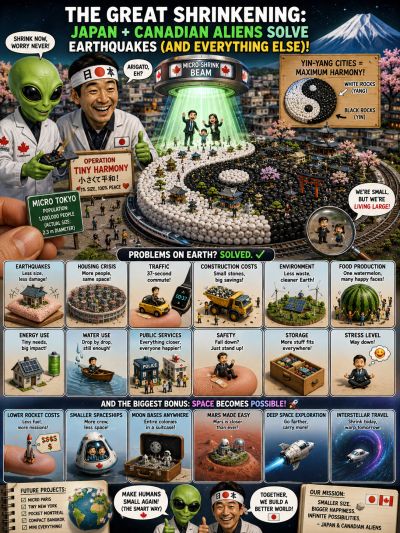
🇯🇵👽 The Great Shrinkening: Japan and Canadian Aliens Unveil the Ultimate Earthquake Solution
Micro Tokyo, Earth Orbit News Network (EONN)
In what experts are calling the most unexpected engineering breakthrough in human history, Japan has officially announced that it has solved the earthquake problem with the help of a team of Canadian aliens.
The project, known as Operation Tiny Harmony, began when a group of extraterrestrial engineers arrived carrying what appeared to be an oversized maple-syrup dispenser.
Hidden inside was a revolutionary device capable of reducing the size of humans, buildings, vehicles, and infrastructure to just 1% of their original scale.
The aliens reportedly asked a simple question:
"Why make buildings stronger when you can make earthquakes bigger than the buildings?"
The room fell silent.
Three years later, the first prototype city was completed near Mount Fuji.
The Yin-Yang City Design
The miniature cities are built using millions of carefully placed black and white stones arranged in giant Yin-Yang patterns.
Alien scientists claim the design creates "harmonic balance fields" that look extremely impressive in aerial photographs and make tourists buy twice as many souvenirs.
Residents of Micro Tokyo now live in neighborhoods small enough to fit inside a shopping mall parking lot.
Problems Solved Overnight
Officials report that the technology has unexpectedly solved dozens of Earth's biggest challenges.
Earthquakes
When buildings are tiny, less material is required.
When less material is required, structures become lighter.
When structures become lighter, earthquakes become less damaging.
When everyone is tiny, even falling over is considered a minor inconvenience.
Housing Crisis
A city that once housed one million people can now fit inside a baseball stadium.
Governments worldwide immediately began converting unused office buildings into entire provinces.
Traffic
The average commute in Micro Tokyo is now 37 seconds.
Rush hour has been replaced by what experts call "a brisk walk."
Construction Costs
One truckload of stone can now build several neighborhoods.
Construction companies are reportedly furious while accountants are celebrating.
Environmental Impact
Tiny cities require far less concrete, steel, fuel, water, and energy.
Carbon emissions dropped so quickly that several climate conferences accidentally ended early.
Food Production
A single rice field can now feed entire regions.
One watermelon is reportedly large enough to support a family reunion.
Transportation
Cars are the size of toy models.
Traffic jams now resemble children playing with collectibles.
Several citizens admitted they accidentally parked inside their own living rooms.
Unexpected Space Benefits
The biggest surprise came when aerospace engineers realized that shrinking humanity dramatically changes space travel.
Rocket Costs Collapse
Smaller spacecraft require less fuel.
Smaller crews require fewer supplies.
A mission that once required a giant rocket can now be launched using equipment previously classified as "large garden machinery."
Faster Exploration
Entire lunar colonies can fit inside cargo containers.
Mars bases can be transported aboard vehicles once used to deliver refrigerators.
Deep-Space Missions
The first Micro Explorer spacecraft recently departed for Jupiter carrying:
- 500 astronauts
- 12 laboratories
- 3 restaurants
- 1 karaoke bar
- A suspiciously large quantity of sushi
All inside a spacecraft smaller than a city bus.
Interstellar Travel
Canadian alien engineers claim that shrinking mass makes future warp-drive systems dramatically easier to operate.
While human scientists remain skeptical, they admit that the aliens have correctly predicted hockey scores with alarming accuracy.
The Global Response
Governments around the world have expressed interest in joining the program.
Several countries have already submitted applications to become "micro nations."
Meanwhile, giant manufacturers are scrambling to adapt.
One furniture company has reportedly begun selling entire living-room sets that fit inside a shoebox.
Looking Ahead
Construction is already underway on:
- Micro Paris
- Mini New York
- Tiny Sydney
- Pocket Montreal
- Compact Bangkok
Officials say future generations may never know what it was like to live at full size.
As the sun set over the first Yin-Yang city, a Canadian alien spokesperson delivered a final message:
"The universe is not asking humanity to become bigger. It is asking humanity to become smarter."
The alien then climbed into a spacecraft no larger than a hockey puck and disappeared toward the Moon.
At press time, scientists were still attempting to determine whether the entire project was a technological revolution or the most elaborate practical joke in galactic history.
🐆🚀 Congo Unveils New Leopard Transformer Fleet for Rapid Rescue Operations
Alien Technology Meets Humanitarian Response
KINSHASA — In a surprise announcement that has stunned military analysts, engineers, wildlife experts, and several confused zoo visitors, the Congolese military has officially unveiled its newest rescue platform:
The Leopard Transformer Series
Developed in partnership with visiting extraterrestrial engineers from the Galactic Emergency Response Alliance, the new vehicles are designed to transform from armored rescue trucks into giant mechanical leopard units capable of reaching disaster zones at unprecedented speeds.
Officials insist the project is focused entirely on humanitarian operations.
"This is not a weapon system," explained General M'Baku during the unveiling ceremony.
"It is an extremely enthusiastic rescue vehicle."
Why a Leopard?
Engineers reportedly evaluated several animal designs.
Rejected concepts included:
- Transformer Hippo (too grumpy)
- Transformer Giraffe (bridge clearance issues)
- Transformer Gorilla (kept challenging construction cranes)
- Transformer Chicken (surprisingly effective but impossible to take seriously)
The leopard won due to its speed, agility, and ability to look impressive in promotional posters.
Capabilities
According to official specifications, each Leopard Transformer can:
- Reach remote villages in minutes
- Cross rivers without bridges
- Clear roads after storms
- Lift heavy debris
- Deliver medical supplies
- Locate stranded civilians using advanced sensors
- Climb mountains faster than helicopters can refuel
The alien guidance system is reportedly so advanced that the vehicles can identify lost hikers by detecting stress, fatigue, and the sound of someone saying:
"I think we're lost."
First Public Demonstration
The first demonstration took place outside Kinshasa.
Spectators watched as a rescue vehicle transformed into a 15-meter-tall robotic leopard and proceeded to:
- Rescue a stranded farmer
- Deliver food supplies
- Repair a damaged bridge
- Return a lost goat
The goat later became an unofficial national celebrity.
Alien Engineers Impressed
Several alien advisors attended the ceremony.
One extraterrestrial engineer expressed admiration for the Congolese team.
"Most civilizations begin with flying cars. Congo skipped directly to rescue leopards."
The statement was met with enthusiastic applause.
New Rescue Academy
To support the growing fleet, authorities have announced the creation of the Leopard Rescue Academy.
Future pilots will receive training in:
- Emergency response
- Terrain navigation
- Mechanical transformation procedures
- Wildlife awareness
- Advanced goat recovery operations
A special course titled:
"How To Avoid Dramatic Entrances"
has reportedly already failed 100% of its students.
International Interest
Several countries have expressed interest in acquiring the technology.
However, alien partners clarified that the transformation system only works when operators possess:
- Courage
- Compassion
- Teamwork
- Proper maintenance records
Many governments immediately requested additional paperwork.
Looking Ahead
Construction of additional Leopard Transformers is already underway.
Officials have hinted at future variants including:
- Jungle Rescue Leopard
- Flood Response Leopard
- Mountain Rescue Leopard
- Medical Evacuation Leopard
Rumors of a Giant Flying Leopard remain unconfirmed.
For now, citizens across the Congo can take comfort knowing that if disaster strikes, a giant robotic leopard may soon come sprinting over the horizon carrying medical supplies, engineers, and possibly a very confused goat.
And thanks to a little extraterrestrial assistance, rescue operations may never be the same again.

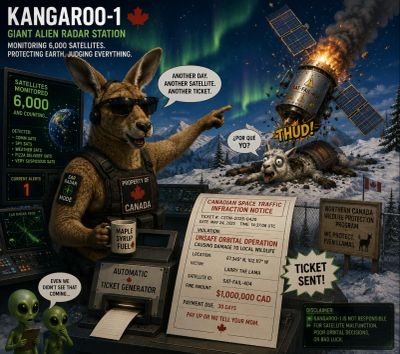
🦘📡 Canada Unveils Giant Kangaroo Alien Radar to Monitor 6,000 Satellites
Northern Canada Becomes Home to the World's Most Unusual Surveillance System
NORTHERN CANADA — In what officials are calling a "completely reasonable and scientifically advanced decision," Canada has officially activated KANGAROO-1, a giant alien kangaroo tasked with monitoring the thousands of satellites currently orbiting Earth.
The enormous marsupial, standing nearly 120 meters tall, has been deployed somewhere deep in the Arctic where temperatures are cold enough to keep both the electronics and the giant animal in an excellent mood.
According to project managers, the living radar system can track more than 6,000 satellites simultaneously while also detecting suspicious weather balloons, lost drones, and forgotten hockey pucks.
A Partnership Decades in the Making
The project reportedly began after Canadian and Australian scientists discovered that giant alien kangaroos possess a natural ability to detect radio signals using their ears.
After extensive testing, researchers found that one giant kangaroo could outperform several traditional radar installations while consuming only coffee, donuts, and occasional maple syrup supplements.
Officials immediately approved construction.
Monitoring Earth Around the Clock
The Kangaroo-1 facility operates 24 hours a day.
Satellite traffic is displayed on giant holographic screens while teams of alien technicians work around the clock analyzing incoming data.
A spokesperson explained:
"The kangaroo can identify weather satellites, communication satellites, military satellites, and even that one weird satellite that keeps taking pictures of parking lots."
The giant animal reportedly provides updates every hour through a sophisticated system of ear twitches and dramatic pointing gestures.
Alien Technicians Impressed
Alien engineers assigned to the facility have expressed admiration for the giant radar marsupial.
One technician stated:
"We originally came to study human technology. Instead we found a giant Canadian kangaroo monitoring the entire planet. Frankly, we are impressed."
Several aliens have already requested transfers to the Arctic facility because of the generous donut allowance.
Security Concerns
Military officials confirmed that the giant kangaroo is now considered strategic infrastructure.
As a precaution, the Evil Kan Motorcycle Squadron has been assigned to protect the site from:
- Ice cream thieves
- Unauthorized UFO tourists
- Rogue space pigeons
- Interplanetary pranksters
- Competitive Australian kangaroos
Security patrols now circle the installation day and night.
Powered by Maple Syrup
Unlike traditional radar systems that rely on massive electrical networks, Kangaroo-1 is powered almost entirely by maple syrup-based fusion technology.
Engineers claim the system is surprisingly efficient.
When asked how the technology works, researchers responded:
"We have no idea. The aliens built it."
Looking Toward the Future
Officials believe the success of Kangaroo-1 could lead to additional deployments.
Future projects reportedly include:
- Moose-based submarine detection systems
- Beaver-powered orbital tracking stations
- Polar bear cyber security teams
- Advanced goose navigation networks
For now, citizens are advised not to be alarmed if they notice a giant kangaroo staring into the night sky.
It is probably just monitoring thousands of satellites, protecting Canada, and silently judging humanity's internet search history.
Scientists agree this is entirely normal.
💧👽 Alien Tech Giant Unveils World's First Steam-Powered Luxury Laptop
Silicon Valley, Earth Orbit — In a shocking announcement that has left technology experts confused and plumbers extremely excited, the alien technology company SteamOS Galactic Industries has unveiled what they claim is the world's most advanced laptop.
The catch?
It runs entirely on water and steam.
The new machine, known as the XE-V9 SteamOS Laptop, resembles an antique Victorian typewriter that somehow married a spacecraft.
Covered in brass, mysterious gauges, glowing alien symbols, and enough pipes to heat a small village, the laptop has already become the must-have luxury item among wealthy intergalactic travelers.
According to Chief Engineer Zorblax-7, electricity is simply "an outdated Earth habit."
"Why waste electrons when you can boil water with style?" he explained while adjusting a pressure valve made from a retired moon rock.
To power the computer, users simply pour distilled water into a crystal reservoir mounted on the side. The water is then heated to exactly 555°C using a miniature alien furnace no larger than a coffee mug.
The resulting steam drives thousands of microscopic turbines hidden inside the machine.
Engineers claim the system can process over 700 trillion cat videos per second, making it one of the most powerful devices ever created.
The luxury version comes equipped with:
- Quantum Steam Cooling™
- Self-polishing brass casing
- Holographic alien assistant
- Built-in tea kettle
- Emergency biscuit warming compartment
- Automatic moustache grooming mode
Not everyone is convinced.
Earth scientists have questioned whether carrying around a boiling water reactor in a laptop is a good idea.
One user reported accidentally launching his kitchen table into low Earth orbit after overclocking the steam pressure settings.
Another customer admitted he spent three hours trying to find the power button before realizing the machine requires a ceremonial whistle to start.
Despite the concerns, demand has exploded across the galaxy.
The first production run of 299 units sold out in under four minutes, with collectors paying up to $19,999 Earth Dollars for a single laptop.
As of publication, several major technology companies are rumored to be developing their own versions.
One prototype reportedly runs on maple syrup.
Canada has already expressed interest.
Whether steam-powered computing represents the future of technology or merely the most expensive kettle ever built remains to be seen.
For now, the XE-V9 stands as proof that somewhere in the universe, there is an alien engineer asking a very important question:
"What if laptops needed more pipes?"

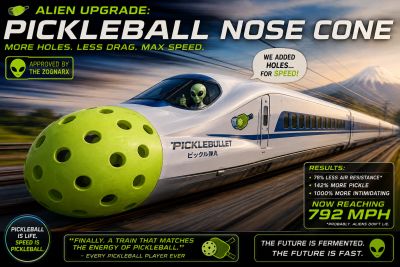
🚄 Alien Engineers Reveal the Pickleball Nose Cone That Makes Bullet Trains "Much Faster"
TOKYO, EARTH — Transportation experts around the world were left speechless today after a delegation of friendly alien engineers unveiled what they claim is the greatest advancement in high-speed rail since the invention of the wheel.
The secret?
Replacing the entire aerodynamic nose of a bullet train with... a giant pickleball.
According to the extraterrestrial design team, humans have spent decades studying wind tunnels, advanced composites, and fluid dynamics while completely overlooking the obvious solution.
"Everyone knows things with little holes go faster," explained Chief Galactic Engineer Zorbax while pointing confidently at a pickleball. "Why else would we put so many holes in it?"
The presentation received a standing ovation from absolutely nobody qualified to verify the science.
The "Alien Logic"
The aliens insist the holes don't create drag—they actually "confuse the air."
"The air spends so much time wondering where it should go that the train has already passed," one engineer explained with complete confidence.
Researchers attempted to ask follow-up questions but became distracted after another alien produced a PowerPoint made entirely of glowing holographic pickles.
Early Test Results
The first prototype reportedly reached incredible speeds while making a gentle "pop... pop... pop..." sound as it rushed down the track.
Passengers reported an unusually smooth ride, although several admitted they developed an overwhelming desire to play pickleball immediately after arriving at their destination.
One commuter said,
"I don't understand the physics, but I've never wanted to buy a paddle this badly."
A New Design Philosophy
Manufacturers are already considering optional upgrades including:
- Dill-flavored emergency brake handles.
- Self-polishing pickleball nose cones.
- Alien cruise control that compliments the driver every 30 minutes.
- A "Tournament Mode" that activates whenever another train appears beside it.
The premium version even includes an onboard holographic referee who loudly announces every station arrival as if it were championship point.
Scientists Remain Skeptical
Human engineers politely reminded everyone that real aerodynamics is considerably more complicated than attaching sporting equipment to public transportation.
The aliens smiled knowingly.
"You'll understand in about 700 years."
They then boarded the prototype train, disappeared over the horizon in seconds, and somehow arrived yesterday.
Authorities are currently unable to explain the timeline discrepancy but admit the train looked surprisingly stylish.
Meanwhile, pickleball manufacturers have denied any involvement, although sales mysteriously increased moments after the announcement.
Whether this revolutionary technology is the future of transportation or simply another example of aliens having an unusual sense of humor remains to be seen.
One thing is certain:
Rush hour has never looked more athletic.
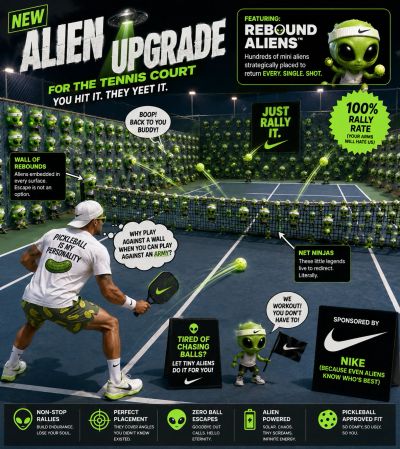
Nike Unveils the "Rebound Aliens™" Upgrade for Tennis Courts
Every missed shot is now officially a thing of the past.
GALACTIC SPORTS DESK
After decades of watching tennis players chase impossible shots into the stands, a team of highly caffeinated alien engineers has announced what they're calling the biggest upgrade in racket sports since the invention of strings.
Introducing Rebound Aliens™
The revolutionary system involves placing thousands of tiny green aliens around every inch of the tennis court—including along the sidelines, the back fence, the net, and even hidden inside the umpire's chair.
Their one and only mission?
Return every single ball.
Each miniature alien has completed over 12 years of advanced Galactic Ball Trajectory Academy, where students learn to calculate spin, speed, wind direction, player ego, and dramatic slow-motion moments before gently redirecting every ball back into play.
"It makes the rallies last forever," explained Supreme Rebound Commander Zibblax while polishing a tiny Nike visor.
"If the players get tired, that's a personal problem."
The first public demonstration featured athletes wearing Nike's newest Pickleball Performance Collection, proving that looking like a pickleball superstar automatically increases confidence by at least 742%.
The collection includes:
- Alien-approved pickleball shorts.
- Aerodynamic visor with optional antenna attachment.
- Shoes scientifically designed for chasing absolutely nothing because the aliens do all the work.
- Moisture-wicking shirts capable of surviving five-hour rallies.
Nike representatives were reportedly delighted.
"We didn't invent the aliens," one spokesperson joked. "We just gave them better shoes."
Professional tennis coaches are divided.
Some believe the technology will create the longest rallies in sports history.
Others worry matches could now continue for several weeks.
Tournament organizers are already considering adding sleeping bags next to Centre Court.
Fans, however, love the idea.
"I've been watching the same rally since Tuesday," said one excited spectator.
"It's magnificent."
Scientists estimate each Rebound Alien can react in less than one-millionth of a second thanks to tiny anti-gravity sneakers powered by concentrated pickle juice and mysterious cosmic optimism.
Even the net has received an upgrade.
Hundreds of "Net Ninjas" now live inside the mesh, politely nudging balls back toward whichever player appears least prepared.
Commentators say the sport has become dramatically more entertaining.
"You never know where the ball is going," one broadcaster laughed.
"Actually... the aliens always know."
Early testing also revealed several unexpected benefits:
- Ball kids now spend most of their day drinking lemonade.
- Spectators have stopped yelling "Out!" because nothing is ever out.
- Players have begun bringing camping equipment for five-day rallies.
- Television broadcasters have requested intermissions every eight hours.
Meanwhile, pickleball enthusiasts have welcomed the fashion crossover with open arms.
"We don't understand why we're involved," admitted one player, "but the outfits are incredible."
Rumors suggest the next upgrade is already under development.
Instead of hawk-eye cameras, matches may soon feature tiny alien referees riding miniature UFOs, issuing line calls while performing synchronized aerial dances during tie-breaks.
Whether this technology reaches Earth remains uncertain.
For now, the Galactic Sports Federation reminds everyone that humans are still expected to practice... at least until the aliens finish installing themselves around every court.
Editor's Note: This article is a work of satire and absurd fiction.
Any resemblance to real sports technology, Nike products, tennis tournaments, pickleball fashion, or tiny extraterrestrial rebound specialists is purely for comedic purposes.
Alien Professor Unveils New Underwater WD-40 Upgrade to Save the World's Historic Submarines
Editor's Note: This article is a work of satire and absurd fiction.
Any resemblance to real products, submarines, professors, or extraterrestrial engineering breakthroughs is purely for comedic purposes.
Rust Officially Declares Defeat
PACIFIC OCEAN — Marine engineers around the world were left speechless today after Professor Zorg-77 of the Galactic Academy of Mechanical Enlightenment unveiled what he described as "the simplest invention humans somehow forgot to invent."
Standing nearly 300 meters beneath the surface beside a collection of aging submarines, the famous alien professor proudly revealed the Galactic Underwater WD-40 Upgrade—a revolutionary formula that can lubricate moving parts, chase away rust, and work perfectly while completely underwater.
The audience erupted into applause.
Mostly because underwater speakers had finally been invented by dolphins.
Saving History Before It Vanishes
According to Professor Zorg-77, thousands of historic submarines slowly disappear every year beneath the ocean, quietly surrendering to rust and time.
"History deserves maintenance," the professor explained while spraying an ancient submarine that immediately began shining like new.
Seconds later...
The hatch opened.
The lights turned on.
The coffee machine inside somehow started brewing fresh coffee despite being underwater since the 1960s.
"It still makes better coffee than the Galactic Headquarters," admitted one alien technician.
Human Engineers Can't Believe Their Eyes
Naval crews from around the world gathered to witness the demonstration.
Most spent the first twenty minutes staring at the spray can.
One engineer finally raised his hand.
"So... you're telling us all we needed was an underwater version?"
Professor Zorg simply smiled.
"Sometimes evolution is just improving something everyone already loves."
The crowd immediately began taking notes.
Even the Fish Signed Up for the Lecture
Schools of fish abandoned nearby coral reefs to watch the presentation.
Octopuses volunteered to become certified underwater mechanics.
A wise old sea turtle was heard saying,
"I've been waiting 143 years for somebody to think of this."
Meanwhile, curious crabs inspected the newly restored submarines, declaring them "excellent new neighborhoods."
Cats Continue Their Scientific Research
As expected, the famous Research Cats arrived carrying waterproof notebooks.
Without saying a word, they carefully documented every detail of the presentation.
Their notes reportedly included:
- Never underestimate simple ideas.
- Rust fears confidence.
- Waterproof pencils were worth the investment.
- Humans clap for everything aliens invent.
One orange cat simply nodded before writing:
"Nine lives... one maintenance schedule."
Scientists called it "surprisingly profound."
The Future Looks Bright
Following the demonstration, governments announced plans to inspect every historic submarine before rust could claim another piece of maritime history.
The alien professor, however, remained humble.
"This isn't about fixing submarines," he explained.
"It's about reminding civilizations that taking care of old things can help build a better future."
The audience applauded once again.
The submarines proudly floated a little straighter.
The fish resumed swimming.
The cats closed their notebooks with satisfaction.
And somewhere deep beneath the waves, rust quietly began looking for a new career.

Houston Unveils Porsche's Incredible Alien Material Breakthrough
HOUSTON, TEXAS — In what experts are calling the most unexpected automotive announcement in history, engineers in Houston have officially revealed that the next generation of Porsche sports cars will be built using an advanced alien material designed not only to improve performance but also to help restore Earth's environment.
According to the cheerful scientists involved in the project, the mysterious material was delivered after a group of highly enthusiastic alien engineers accidentally landed at a barbecue competition outside Houston.
Instead of asking for directions back to their galaxy, they reportedly handed over a glowing sample of a substance capable of doing things no known material on Earth can accomplish.
The futuristic alloy is said to become stronger as it absorbs pollution, repair microscopic scratches on its own, and even encourage nearby plants to grow faster simply by parking beside them.
One researcher joked that owners might eventually receive thank-you cards from neighborhood squirrels for improving local air quality.
Houston quickly became the command center of the entire operation.
Hidden beneath an ordinary-looking aerospace research facility, engineers, mechanics, and visiting alien professors worked together around the clock to adapt the material for high-performance sports cars while making sure it remained stylish enough to satisfy Porsche enthusiasts.
The alien engineering team insisted that speed was only part of the equation.
"Going fast is fun," explained the team's lead engineer through a universal translator, "but going fast while helping the planet is much more impressive."
To celebrate the breakthrough, several alien interns organized a victory parade through the laboratory using miniature electric hover carts shaped like tiny Porsche models.
Witnesses described the celebration as "extremely professional until the disco music started."
Rumors also suggest that future models may feature optional self-cleaning paint, seats that gently encourage drivers to stretch during long journeys, and an intelligent body shell that politely refuses to let anyone litter out the window.
Meanwhile, Houston officials have embraced their unexpected new role as Earth's headquarters for environmentally friendly extraterrestrial automotive research.
Local restaurants have reportedly added "Alien Engineer Specials" to their menus, while souvenir shops have begun selling "Made with Houston & Alien Technology" bumper stickers.
Although neither Porsche nor the visiting aliens would reveal exactly how the remarkable material works, they confirmed that additional upgrades are already being tested somewhere "slightly above Earth's atmosphere."
As for the alien engineers, they thanked Houston for its hospitality before disappearing into a glowing spacecraft, promising to return soon with "Version 2.0"—a material so advanced that even parking tickets reportedly become biodegradable.
Editor's Note: This article is a work of satire and absurd fiction. Any resemblance to real companies, scientific breakthroughs, or extraterrestrial engineering projects is purely coincidental and intended for humorous entertainment.

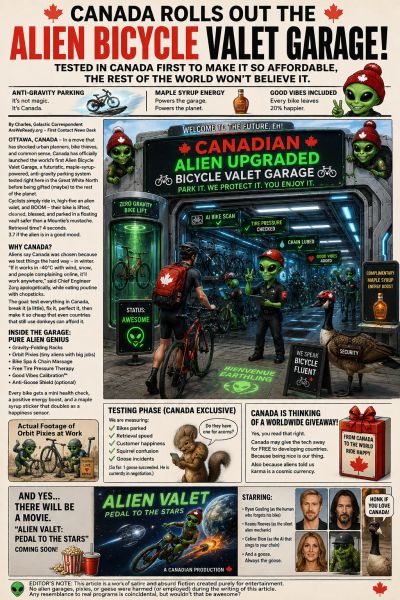
Canada Tests Alien Bicycle Valet Garage and Considers Giving It Away to the World
Canada has officially entered the future, and apparently, the future comes with a bike rack, a smiling alien valet, and a complimentary maple syrup energy boost.
In a move that has shocked urban planners, cyclists, thieves, squirrels, and several confused geese, Canada is now testing the world’s first Alien Upgraded Bicycle Valet Garage — a futuristic parking system designed to make bicycles safer, cities cleaner, and humans slightly less dramatic when they lose their lock key.
The technology is being tested in Canada first because, according to alien engineers, “if it works in Canadian weather, it will work anywhere except maybe inside a volcano.”
The garage uses anti-gravity bike lifts, AI tire-pressure scanners, chain-lubing robots, and tiny alien mechanics known as Orbit Pixies.
Cyclists simply arrive, hand over their bike, and watch as the bicycle is lifted into a glowing zero-gravity storage tunnel.
Retrieval time: four seconds.
Emotional healing time after seeing your bike treated better than your car: unknown.
Canada says the goal is not only to create the safest bike garage on Earth, but to make the technology affordable enough for the rest of the world.
Instead of building massive concrete parking structures, the alien system folds bicycles into a compact floating storage pattern called “polite gravity.”
Officials say this could reduce construction costs, save space, and finally stop people from locking bikes to trees, fences, statues, and emotionally unavailable parking meters.
The first Canadian tests are measuring several important things: how fast bikes can be stored, how happy cyclists become, how many squirrels try to register as customers, and whether geese can be trusted near the valet counter.
So far, results are promising.
Only one goose successfully stole a bicycle.
Canada is also reportedly considering a worldwide giveaway program.
The idea would allow developing cities and crowded urban centres to receive the alien bike garage technology for free or at a very low cost.
One Canadian official explained, “We tested it here first because we wanted to break it, freeze it, confuse it, cover it in snow, and expose it to a goose. Now that it survived all that, we believe humanity is ready.”
The aliens support the giveaway, but only under one condition: every country must promise to use the garage for bikes, not secret submarines, shopping carts, or storing uncles who talk too much at family parties.
But the story does not stop there.
Canada is also thinking about making a movie to celebrate the project.
The working title is:
Alien Valet: Pedal to the Stars
The film would follow a humble Canadian cyclist who forgets where he parked his bike, only to discover that his bicycle has been accidentally launched into orbit by an alien valet trainee named Zorp.
The movie will reportedly include a dramatic chase scene through a zero-gravity bike tunnel, a goose security officer, a maple syrup-powered spaceship, and one emotional scene where a mountain bike forgives its owner for never cleaning the chain.
Rumoured cast members include one very polite alien, one extremely serious Canadian cyclist, one talking helmet, and a goose who refuses to sign a contract unless paid in breadcrumbs.
The soundtrack may feature dramatic orchestral music mixed with bicycle bells and motivational honking.
Urban experts say the movie could help the public understand the technology while making cycling look cool, safe, and slightly ridiculous.
Meanwhile, cyclists who tested the garage say the experience is unforgettable.
“My bike came back cleaner than when I bought it,” said one rider. “The alien even adjusted my seat, blessed my tires, and told me I had strong calves. I cried a little.”
Another cyclist said, “I don’t know what happened inside that garage, but my bike now smells like maple syrup and makes better life choices than me.”
Canada hopes the pilot project will prove that futuristic transportation does not have to be expensive, cold, boring, or controlled by angry parking machines.
Sometimes, it can be green, glowing, polite, and operated by aliens wearing red tuques.
For now, the Alien Bicycle Valet Garage remains in testing, but if the results continue to improve, cities around the world may soon receive their own affordable version.
When that happens, every bike on Earth may finally have a safe place to sleep.
Except the goose’s bike.
That one is still under investigation.
Editor’s Note: This article is a work of satire and absurd fiction created purely for entertainment.
The alien bicycle valet garage, Orbit Pixies, goose security officers, and maple syrup-powered anti-gravity technology are not real.
Any resemblance to real transportation programs, governments, cyclists, or suspiciously organized geese is purely coincidental.
Germany's New Alien Defense Upgrade Backfires... Into the Most Positive Forest Festival Ever
Residents across a quiet German forest were left speechless this week after the country's experimental "Mr. Salt Rocket Launcher Program" entered its first public field test.
The concept sounded simple enough.
Military engineers reportedly designed oversized launchers capable of firing cans of the legendary Mr. Salt soft drink directly toward mysterious aliens who had recently taken up residence in elaborate treehouses high above the forest canopy.
Officials believed the fizzy beverages would encourage the visitors to relocate.
Instead...
Something completely unexpected happened.
As the first wave of spinning soda cans rocketed through the air, the tree-dwelling aliens calmly raised glowing blue energy fields around themselves.
Witnesses say every can instantly transformed into sparkling clouds of colorful light before gently raining back down as tiny glowing bubbles.
Rather than exploding, each can released waves of laughter that echoed through the forest.
"It tasted surprisingly refreshing," one anonymous alien reportedly said while catching another can with a tiny golden umbrella.
Within minutes the visitors demonstrated what they called Positive Matter Transmutation, an advanced technology capable of converting almost any object launched toward them into something joyful.
The soda became harmless fountains.
The rocket smoke became rainbow-shaped clouds.
Even the loud launchers somehow began playing cheerful accordion music every time another can was fired.
Military analysts admitted they had not included "turning artillery into a forest party" anywhere in their prediction models.
Birds began dancing.
Squirrels formed an organized cheering section.
Several curious deer reportedly lined up hoping another volley would begin because "the bubbles smelled delicious."
By the afternoon, German engineers stopped firing altogether and instead started taking notes while the aliens demonstrated their strange technology.
According to the visitors, the upgrade isn't actually about avoiding attacks.
"It's about transforming negative energy into positive energy," explained one smiling alien while handing a soldier a freshly chilled Mr. Salt can. "Everything sent with tension can become something useful when processed with enough joy."
The demonstration soon evolved into what observers jokingly described as the world's first Intergalactic Forest Soft Drink Festival.
Military personnel and aliens were seen exchanging recipes, engineering ideas, and surprisingly competitive tree-climbing techniques.
Several scientists have already suggested studying the aliens' "Positivity Transmutation Field," believing similar technology could one day help recycle pollution, reduce waste, and even transform stressful situations into opportunities for cooperation.
As for the famous rocket launchers?
Officials confirmed they won't be retired.
Instead, they may be redesigned as the world's first high-speed beverage delivery system for international picnics.
The aliens reportedly gave the project an enthusiastic thumbs-up.
And yes...
They asked if Germany could send the next shipment chilled.
Editor's Note: This article is a work of satire and absurd fiction created for entertainment.
Any resemblance to real military programs, alien civilizations, or soft drink launchers is purely coincidental and intended as comedy.

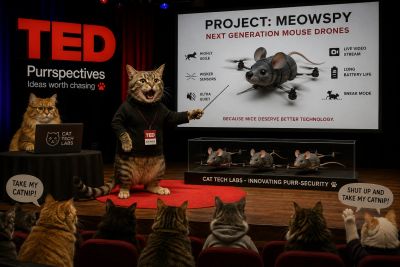
Cats Unveil Revolutionary Mouse Drones at Annual TED Talk
Experts Call It "The Greatest Leap Forward in Napping Technology Since the Cardboard Box."
SAN FRANCISCO—The world's smartest cats gathered today for the annual TED (The Extraordinary Discussion) conference to reveal what scientists are already calling the future of feline innovation: autonomous mouse drones.
Standing proudly on stage in a tiny black turtleneck, Professor Whiskerton Meow III introduced the invention to a sold-out audience of cats, kittens, and one very confused golden retriever who accidentally wandered into the auditorium looking for free snacks.
"Our ancestors chased mice for thousands of years," announced Professor Whiskerton while dramatically pointing at a giant presentation screen.
"But why waste precious nap time when technology can do the chasing for us?"
The crowd erupted into thunderous applause, interrupted only by several audience members suddenly falling asleep in the front row.
The new drones resemble ordinary mice but are equipped with whisper-quiet propellers, laser-guided snack detection, and an advanced artificial intelligence system capable of locating abandoned tuna sandwiches from nearly three kilometers away.
Engineers demonstrated several impressive flight modes:
- Stealth Squeak Mode for sneaking under refrigerators.
- Zoomie Mode for confusing dogs.
- Midnight Apartment Sprint Mode, activated automatically at exactly 3:17 a.m.
- Human Foot Attack Simulation, designed to make owners believe they almost stepped on something alive.
According to Cat Tech Labs, early testing exceeded all expectations.
"The drones successfully distracted humans long enough for our volunteers to knock thirty-seven coffee mugs off tables," explained lead engineer Sir Fluffington while trying not to laugh.
"That represents a 98% increase in operational efficiency."
Investors immediately became interested.
Several wealthy Persian cats reportedly offered unlimited catnip funding, while a group of Maine Coons proposed expanding the technology into the home security market.
"We're also developing pigeon drones," one executive whispered. "Please don't tell the birds."
The only criticism came from the International Mouse Union.
Spokesmouse Bernard Squeakers called the invention "deeply unfair," adding that real mice have spent generations perfecting evasive maneuvers only to discover they were now competing with rechargeable coworkers.
Negotiations quickly broke down after a kitten accidentally pressed the demonstration button, sending twelve mouse drones racing around the conference hall while hundreds of cats instinctively forgot they were attending a serious technology summit.
The presentation officially ended when every speaker, investor, journalist, and security guard abandoned their seats to chase the drones across the stage.
Experts later described the event as "the most productive meeting cats have ever held."
Professor Whiskerton closed the conference with a simple message:
"Technology should never replace the joy of chasing things."
He paused dramatically.
"It should simply make sure the things are easier to find after your afternoon nap."
The audience responded with a standing ovation, followed by another nap.
Industry analysts now expect the first commercial Mouse Drone to launch sometime next year—assuming the engineering team can stop batting the prototypes under the couch.
Canada Unveils World's First Onion Ice Cream That Secretly Updates Grandma's Neuralink
OTTAWA, CANADA — Canadian scientists, dairy farmers, and several highly enthusiastic extraterrestrial interns have officially unveiled the world's first Onion Ice Cream, a revolutionary frozen dessert that promises not only a unique flavor experience but also a complimentary upgrade for your grandmother's Neuralink.
The announcement has completely divided the internet.
Half of Canadians immediately wanted to try it.
The other half wanted to know if ketchup chips could be mixed into it.
According to the Ministry of Extremely Questionable Culinary Experiments, the recipe combines premium Canadian cream, locally grown onions, maple syrup, and a tiny amount of classified alien quantum seasoning that "may or may not increase grandma's Wi-Fi signal."
Researchers insist the onions are not there for flavor alone.
"They're actually the antennas," explained one smiling alien engineer while adjusting a floating holographic recipe book.
"Humans keep thinking onions are vegetables.
They're actually biological communication satellites."
Grandmothers from across Canada quickly volunteered for testing.
Most admitted they were only there because someone mentioned free ice cream.
Within seconds of finishing the first scoop, remarkable changes began to occur.
One grandmother suddenly remembered where she had hidden her Christmas cookie recipe back in 1987.
Another immediately connected to every family group chat at the same time and started sending motivational messages in fourteen different languages.
One proudly announced she could now remember every birthday, every anniversary, and exactly who still owed her twenty dollars from 1998.
Scientists called the results "deeply concerning... but incredibly impressive."
The alien technicians explained that every container of Onion Ice Cream contains microscopic quantum onions that synchronize with the latest Neuralink firmware using something they call Emotional Vegetable Computing™.
Unlike ordinary software updates that require electricity, the Canadian version only requires two scoops and a polite conversation about the weather.
The side effects have been equally extraordinary.
Several grandmothers developed the ability to knit sweaters before buying the yarn.
One began predicting lottery numbers with surprising accuracy, although she continued choosing birthdays instead because "that's more fun."
Another somehow learned how to use every television remote in the house without asking for help.
Perhaps the biggest breakthrough came when one grandmother finally managed to explain to her grandchildren why they should always wear a jacket outside.
For the first time in recorded history...
They actually listened.
Meanwhile, Canadian ice cream shops are struggling to keep Onion Ice Cream in stock as tourists travel from around the world hoping to receive what experts are calling "the tastiest software update ever created."
Several technology companies have reportedly contacted the aliens to license the recipe, but negotiations remain difficult because the extraterrestrials insist payment must be made entirely in maple syrup and knitted blankets.
Despite the enormous success, Canadian officials continue reminding citizens that Onion Ice Cream should be enjoyed responsibly.
Especially if your grandmother suddenly begins speaking fluent Galactic, starts correcting GPS satellites, or casually mentions that she remembers the dinosaurs "from before they were popular."
For now, Canadians are simply proud that once again they have given the world something nobody expected.
Whether Onion Ice Cream becomes the future of frozen desserts or simply the strangest thing ever served in a waffle cone, one fact is undeniable:
Grandma has never been running on newer software.

Feline Scientists Unveil the World's First "Mommy Cat Braw"
Kittens Everywhere Celebrate
FELINE RESEARCH CENTER — After years of intense scientific work, countless naps, and several million bowls of tuna, the world's greatest cat inventors have proudly introduced what experts are calling the biggest breakthrough in feline motherhood since the cardboard box.
Introducing...
The Mommy Cat Braw™.
Yes, that's Braw, not bra.
According to the lead inventor, Professor Whiskers McFluffington, the extra "W" stands for "Wonderful."
"It also stands for 'We forgot how to spell," he admitted while chasing a laser pointer during the official press conference.
The revolutionary invention promises to make life easier for busy mommy cats juggling kittens, naps, snack breaks, and staring silently at invisible ghosts in the hallway at 3 a.m.
The Braw features:
- Paw-print comfort cups.
- Automatic kitten alignment technology.
- Anti-scratch cuddle fabric.
- Built-in emergency treat pocket.
- Aerodynamic zoomie support.
- A tiny compartment that somehow always contains catnip.
Researchers say every prototype was tested by over 5,000 volunteer kittens whose only qualification was being extremely adorable and completely unhelpful.
The testing process wasn't easy.
Several kittens refused to leave the product because they believed it was a bed.
Others declared it a mountain to conquer.
One simply fell asleep halfway through the evaluation and was immediately promoted to Senior Quality Assurance Officer.
Cat fashion critics initially laughed at the design.
That changed after several glamorous mommy cats strutted down the International Catwalk in Paris wearing the Braw while simultaneously feeding kittens, sipping cream, and ignoring every human in the room.
Fashion magazines immediately called it:
"The purr-fect combination of elegance, engineering, and complete feline chaos."
Major pet companies are already competing for manufacturing rights.
Meanwhile, dogs have reportedly formed an emergency committee after realizing they had absolutely no idea what was happening but felt they should bark about it anyway.
Even the Alien Cat Council from the Andromeda Galaxy sent representatives to congratulate Earth.
Their official statement read:
"Congratulations, Earth cats. You have finally achieved Level Seven Motherhood."
The aliens then presented the inventors with a golden scratching post and disappeared inside a flying saucer shaped suspiciously like a giant ball of yarn.
Sales of the Mommy Cat Braw are expected to begin as soon as engineers solve one final technical issue:
Every finished model keeps getting stolen by kittens who insist it's their new favorite pillow.
Scientists estimate the delay could last anywhere between three days and forever.

CIA Unveils "Espresso Vision" Glasses That Grow, Brew, and Serve Coffee Before You Even Ask
LANGLEY, VIRGINIA — In what experts are calling the world's most unnecessary yet strangely impressive invention, a mysterious research division has reportedly unveiled a revolutionary pair of experimental glasses capable of growing coffee, roasting the beans, brewing espresso, and delivering it directly into the wearer's mouth, all without using their hands.
According to totally unverified rumors from people who definitely enjoy too much caffeine, the project was originally designed to help agents stay awake during extremely long stakeouts.
However, after one engineer accidentally attached a miniature coffee plantation to the side of the prototype, the team realized they had created something far more important.
The new glasses reportedly contain two tiny coffee plants growing in microscopic climate-controlled gardens.
Whenever a bean reaches perfect ripeness, a robotic arm no larger than a mosquito politely harvests it before sending it through an ultra-miniature grinder.
The freshly ground coffee then enters what engineers proudly describe as "the world's smallest luxury café."
Inside each lens frame are tiny espresso machines complete with miniature kettles, filters, heating elements, pressure pumps, temperature sensors, milk frothers, and even microscopic ceramic cups that nobody will ever actually use.
To ensure maximum flavor, a team of nano-sized robotic baristas each wearing a tiny apron and even tinier mustache carefully supervise every step of the brewing process.
Sources claim they argue passionately over extraction times despite being only a few millimeters tall.
When the espresso reaches perfection, an elegant carbon-fiber delivery tube gently swings toward the wearer's mouth and serves the drink with remarkable precision.
The glasses reportedly recognize whether the user prefers espresso, cappuccino, latte, or iced coffee simply by analyzing facial expressions.
If the wearer looks sleepy, the system automatically increases caffeine levels.
If the wearer smiles, it adds latte art.
If the wearer yawns twice, emergency double espresso mode activates.
Engineers also included a "Grandma Mode," which serves coffee together with tiny imaginary cookies "because that's just good hospitality."
Early testers say the experience is incredible.
"I blinked and somehow received a perfect cappuccino," said one volunteer.
"The tiny baristas even applauded themselves afterward."
Another tester admitted the glasses made airport security slightly complicated.
"They asked why my sunglasses contained a rainforest, three espresso machines, two milk frothers, and twenty-seven tiny employees."
Coffee companies around the world are reportedly both fascinated and terrified.
Traditional cafés fear customers may no longer need to wait in line if every pair of sunglasses comes equipped with a fully operational gourmet coffee shop.
Meanwhile, fashion designers have embraced the concept, calling the bulky mechanical eyewear "the hottest accessory for people who believe caffeine should literally follow them everywhere."
Several universities are already studying the invention, hoping to discover how an entire coffee ecosystem somehow fits onto a pair of glasses without spilling a single drop.
As for the tiny robotic baristas, they remain extremely proud of their work.
Witnesses say they can often be heard celebrating after every successful brew while practicing synchronized coffee dances between espresso cycles.
Whether these miraculous glasses ever reach the public remains uncertain.
But one thing is already clear:
The future of wearable technology apparently smells like freshly roasted coffee.

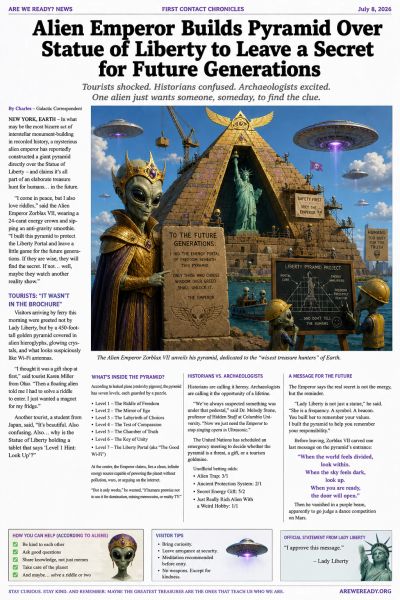
The Pyramid Nobody Was Supposed to Find
First Contact Chronicles
There are two kinds of people in New York.
Those who look at the Statue of Liberty and see history.
And those who apparently look at it and think, "You know what this place needs? A giant pyramid."
As ridiculous as that sounds, newly translated alien documents insist that this is exactly what happened over 30,000 years ago.
According to the scrolls, an alien emperor known only as Emperor Xal'Tor the Patient arrived on Earth searching for the perfect place to hide what he described as "humanity's homework."
The location?
Liberty Island.
Not because the statue existed—it wouldn't for thousands of years—but because the island supposedly sat on one of Earth's rare "resonance portals," places where consciousness, curiosity and the occasional lost tourist all seemed to converge.
Naturally, the emperor ordered a pyramid.
Not a small one.
An absolutely ridiculous one.
Alien construction crews worked day and night using anti-gravity cranes while flying supervisors argued over whether the glowing crystal should be "slightly more mysterious."
Workers reportedly complained that the project was unnecessary.
"We could just leave a note," one engineer allegedly suggested.
The emperor refused.
"If humans discover everything too easily," he declared, "they'll never appreciate the answer."
So the pyramid was built anyway.
Inside, there were no piles of gold.
No secret weapons.
No doomsday device.
Just hundreds of rooms containing increasingly confusing clues.
One chamber simply contained a mirror.
Another held a chair with a sign reading:
"Sit here until your ego calms down."
One hallway looped endlessly until visitors admitted they had absolutely no idea where they were going.
Alien architects considered this "excellent educational design."
The final chamber reportedly contained what the emperor called the greatest treasure in the galaxy.
After decades of speculation, researchers finally translated the inscription.
It read:
"Congratulations. Curiosity brought you here."
Underneath was a second message.
"Now go outside."
Historians admit this was... unexpectedly wholesome.
The greatest mystery, however, remained.
Why build it over Liberty Island?
Ancient records claim the emperor wanted future civilizations to one day build a monument celebrating freedom directly above the hidden chamber.
He believed humanity would eventually become advanced enough to understand that freedom wasn't just political.
It was the freedom to ask questions.
To imagine.
To laugh.
To disagree without becoming enemies.
To remain curious long after everyone else declared the mystery solved.
Thousands of years later, humans unknowingly built the Statue of Liberty almost exactly where the emperor had predicted.
Alien historians reportedly applauded.
One was even heard saying,
"I told you they'd put something dramatic there."
Modern archaeologists continue scanning beneath Liberty Island with increasingly sophisticated equipment.
Every few months they discover another strangely geometric structure.
Every few months someone insists it's just bedrock.
Every few months another alien tourist quietly takes a selfie before flying home.
As for Emperor Xal'Tor?
Legend says he still visits Earth once every century.
Not to inspect the portal.
Not to recover the treasure.
Simply to check whether humans have finally figured out that the greatest secret was never hidden inside the pyramid.
It was hidden inside the people looking for it.
Until then, the emperor is said to be perfectly content sitting invisibly on a nearby cloud, watching tourists pose for photographs while whispering to himself,
"They're getting warmer."
Or maybe he's just waiting for someone to look at the Statue of Liberty and ask the one question no guidebook has ever answered:
"What if this wasn't the first monument built here?"
Secret Asian Nation Unveils Alien-Upgraded Rocket Launcher That Fires Hot Dogs
HAPPY VALLEY, ASIA — A secret nation hidden somewhere between several mountains, three suspicious clouds and a road that does not appear on any map has revealed its newest military breakthrough: a rocket launcher capable of firing fully cooked hot dogs over extremely long distances.
The weapon, officially named the HD-OG1 Intercontinental Sausage Delivery System, was reportedly upgraded by a team of extraterrestrial engineers after local officials complained that their traditional rocket launcher was “too serious, too expensive and completely useless during lunch.”
The alien upgrade has transformed the old launcher into what military commanders are calling the most delicious defensive system in modern history.
“This is not merely a weapon,” declared General Bao Bun, commander of the Happy Valley Strategic Snack Division.
“This is a complete change in global cuisine-based security.”
During a top-secret demonstration attended by hundreds of soldiers, aliens and one confused hot dog vendor, the launcher fired a mustard-covered sausage high above the jungle.
The hot dog reached an altitude that officials described as “probably very high” before landing perfectly inside a bread roll nearly 14 kilometres away.
The crowd immediately erupted in celebration.
Several soldiers raised signs reading, “WE CAN NOW SHOOT HOT DOGS!” while alien technicians exchanged serious nods and updated their tablets.
The Alien Upgrade
According to military sources, the aliens arrived in Happy Valley several weeks ago after detecting what they believed was an advanced distress signal.
The signal was later discovered to be a broken microwave oven repeatedly beeping inside the officers’ cafeteria.
Although disappointed by the mistake, the aliens agreed to stay after being offered unlimited noodles, karaoke access and diplomatic immunity from parking tickets.
The extraterrestrial engineers inspected the country’s outdated rocket launcher and quickly identified several major problems.
“It had no flavor guidance system, no automatic mustard calibration and absolutely no emergency napkin compartment,” explained lead alien engineer Zorp-77 through a translator.
Within six days, the aliens installed a glowing green propulsion chamber, a sausage stabilization tube and an artificial intelligence system capable of calculating the exact amount of ketchup required for any target.
The upgraded launcher can reportedly fire several types of ammunition, including:
- Classic hot dogs
- Cheese-filled sausages
- Spicy chili dogs
- Vegetarian emergency projectiles
- Extra-long ceremonial hot dogs
- A mysterious blue sausage that officials have been advised not to eat
The launcher can also operate in “festival mode,” which fires hot dogs slowly into the air while playing dramatic music.
A New Era of Deterrence
Happy Valley’s government insists the launcher is intended for defensive purposes only.
“Our nation seeks peace,” said Minister of Snacks Lin Mustard.
“But peace is easier to maintain when your neighbours know you can deliver lunch from 300 kilometres away.”
The government has not revealed the maximum range of the weapon, although witnesses claim one test hot dog accidentally crossed two borders and landed inside a businessman’s convertible.
The businessman reportedly ate it and described the incident as “surprisingly convenient.”
Military analysts are already debating how the hot dog launcher could change regional security.
Some believe the system could reduce conflict by making enemy troops too busy eating to continue fighting.
Others warn that rival countries may begin developing their own food-based weapons, possibly creating a dangerous international snack race.
Satellite images have already shown unusual activity in nearby nations, including the construction of what appears to be a giant hamburger catapult and several underground pizza silos.
International Reaction
World leaders responded cautiously to the announcement.
One Western official said the new launcher was “deeply concerning but also strangely appetizing.”
Another government requested an emergency meeting to discuss whether mustard should be classified as a chemical weapon when used in excessive quantities.
The United Nations has reportedly created a special committee called the International Council for Ballistic Food Safety, although its first meeting was postponed after delegates argued for three hours about whether a hot dog is technically a sandwich.
The aliens, meanwhile, have rejected accusations that they are destabilizing the region.
“We are not creating war,” said Zorp-77. “We are improving catering logistics.”
Soldiers Welcome the Change
Morale among Happy Valley’s troops has risen dramatically since the upgrade.
Under the old system, soldiers spent long hours cleaning metal rockets, checking explosives and completing complicated safety forms.
Now they spend most of their training learning how to load buns without tearing them.
“We used to fear missile practice,” said Private Noodle Chen. “Now we bring onions.”
Military uniforms have also been modified to include mustard-resistant pockets, emergency relish packets and a special medal awarded to soldiers who successfully catch a hot dog without using their hands.
General Bao Bun has promised that no soldier will ever again be sent into battle without proper condiments.
“That is now written into national defence policy,” he confirmed.
The First Operational Mission
The hot dog launcher may soon face its first real-world test.
A remote village recently reported that its annual summer festival had run out of food after the delivery truck became stuck behind a goat.
The military immediately placed the HD-OG1 on standby.
Officials say the launcher could deliver 800 hot dogs, 400 buns and several gallons of mustard in under four minutes.
However, engineers are still working on a technical problem involving onions separating from the hot dogs during high-speed flight.
“We have lost many onions,” admitted one technician while staring sadly toward the mountains.
Bigger Plans Ahead
Happy Valley’s government has already announced plans to expand its alien-assisted defence program.
Future projects may include a popcorn cannon, a dumpling drone fleet and a submarine capable of launching soup.
There are also rumours of an experimental dessert weapon known only as Project Flying Donut.
General Bao Bun refused to confirm the project but warned journalists not to stand near open windows during testing.
For now, the secret nation is celebrating its historic achievement.
As the sun set over the jungle base, soldiers shared freshly launched hot dogs with their alien allies while patriotic music played from a nearby food cart.
Above them, another sausage streaked across the sky, leaving behind a trail of smoke, mustard and international confusion.
One thing is certain: the future of warfare may still be dangerous, unpredictable and expensive.
But at least lunch will arrive on time.
Editor’s Note: This article is fictional satire created for humor and entertainment.
No real country, military or extraterrestrial hot dog program is being reported.